Saturday, August 4, 2007

Purnama: Full Moon

Purnama, or full moon in Bali is always a special day for ceremonies and festivities. Hundreds of temples all over the island celebrate their anniversary on a specific full moon each year. Since full moon is also considered as an auspicious day, hundreds of ceremonies are held in all corner of the island on this sacred day. When a holiday such as Galungan is happen together with the purnama, the scale of the festivity and ceremony of this holyday is doubled, with more offerings and decoration than a Galungan without purnama.
Balinese believe purnama is a propitious day when God descends to the earth and gives His blessing. Balinese make special offering to the God in this holyday, give alms, reciting religious hymn, or set a pilgrimage to a remote temple, but for teenagers, the Jagatnatha Temple in the heart of Denpasar is the only destination. Balinese also believe that purnama is the best time for making good deeds or doing religious activities since the reward of them will be multiplied by 100.
Some purnama are considered superior than others. Purnama of Kadasa (tenth month of Balinese Caka calendar or April in Gregorian) is considered the brightest purnama. Purnama of Kapat (fourth month of Balinese Caka calendar or October in Gregorian) and Purnama of Kalima (fifth month of Balinese Caka calendar or November in Gregorian) are also considered superior.
Lately, in accordance with Ajeg Bali (Bali Stand Strong) spirit, every purnama, civil servants, teachers, and students wear Balinese traditional clothes and hold morning communal praying in their offices or schools. In the evening, the street of Denpasar or other cities in Bali will be crowded with thousands of pilgrims on their way to pay homage and pray in Jagatnatha temple of their respective regency that is located in the heart of regency’s capital city.
The religious activities on every purnama are usually last until midnight especially the reciting of religious hymn and the pilgrimage of the teenagers to the Jagatnatha Temple. Some Balinese also meditate on this sacred day until late at night.
Balinese Women
Speaking about Balinese women, we will speak about endurance, patience, love and care and of course, hard workers. The women do all the work while men go to tajen (cockfighting) is the image of Balinese society seen by the outsider and there is some truth in it. The cockfighting is seldom held nowadays maybe once in a month or two, but the Balinese women are still a hard worker.


Balinese women are independent women, tough and hard working. The household duties that are entrusted to the women are exhausting and need a lot of patience such as taking care of the households, preparing the religious offering, taking care of the children, managing the budgets and working in the rice field or office.


Balinese women are the backbone of Balinese society and culture. In other societies, men are the ones involved in trade but in Bali, the buying and selling activity is the privilege of women. When you visit a Balinese traditional market, you are entering a women’s kingdom. Streets are filled with warung (food and daily needs stalls) run by the women. In the households, it is the women who keep the money. Men usually hand their income to them so that it is managed in the right way. Women also play the central role in the ritual process from the preparation for the ceremony to the actual running of the ceremony. The women start to prepare the ceremony a month before the day on which the ceremony will be held but men start to work for the ceremony a week or less before the ceremony is held.


In the political and social life of the banjar (sub village) or village, sometimes women are inferior to men. In Banjar meetings or village meetings there are no woman participants. The decisions that are made rarely take any notice of women’s interests. There is no theoretical discrimination between men and women although in practice, both men and women have their own traditional responsibilities. Women sell in the market, buy the daily need, cook, take care of the children and do the household duties. Besides working in the rice field or office, men attend to their banjar duties and participate in banjar or village activities that are more like a gathering than a duty or work.
TAJEN: Balinese Cockfighting
 Cockfights are staged in Bali on auspicious days in conjunction with Hindu ceremonies that require a sacrificial blood offering.
Cockfights are staged in Bali on auspicious days in conjunction with Hindu ceremonies that require a sacrificial blood offering. The spilt blood is combined with a series of complicated purification offerings to appease the negative forces of the underworld. The Balinese believe that by performing such rites they are satisfying the hunger of the evil spirits that often disturb man and his environment. Chickens are used as they are one of the most accessible creatures from the animal kingdom that roam around village compounds with relative freedom in search of food scraps.
Cockfights for religious purposes are usually staged within the outer courtyard of a temple complex and consist of only a couple of rounds using different cocks each time. Those attending dress accordingly, in traditional sarong and behave as if they are attending any other ceremonial event.
However, the Balinese obsession with gambling means that some cockfights, or tajen as they are locally known, are sometimes staged for pure pleasure. Although gambling in Indonesia is considered highly illegal, recreational cockfights are held around the island, but in relative secrecy. Police crackdowns in recent years have seen a huge decline in this blood sport that was once a thriving activity for village men.


Negotiations take place between the owners of the cocks as well as some minor preparations before the commencement of the fight. A professional handler positions and tightly binds razor sharp blades to the natural spur of the claw of each cock. Betting from the audience begins and it is a noisy affair with bids and odds shouted from each end of the arena.

Friday, August 3, 2007
Villa in Bali
Villas are great places to enjoy your holiday. The advantage of a villa over a hotel room / suite, is privacy and independence. Some people are happy to take a private entrance, pool, kitchen etc. over 24 room service and villas are abundant in Bali. Many hotels offer a choice of standand block rooms or private villas with their own perimiter wall and pool. for fmaily groups or honeymooners this can be a great way to go. There are also privately owned villas which are just stand alone properties. Looking around online you’ll see some high prices quoted, but slightly away from the action in places like Kerobokan you can find cute, modern places with very nice facilities, 1 bedroom, and pool for US$60 a night. Seminyak is a hot spot for villas and you’ll find quality if expensive places on the beach side of Jl. Seminyak, just north of Jl. Double Six.
Behind Bintang supermarket in Seminyak there is actually a lot of open land still used to graze cattle! The narrow lanes that connect that area with Jl. Dhyana Pura offer a multitude of cheap looking long term villa rentals plus a few nicer places. One of those is Dyana Villas, which offers neat 1 bedroom places with pool for $120 a night.
Dyana Villas
Jl. Abimanyu, Gang Bunga Kecil
Seminyak
(0361)734775
 Down on the Bukit peninsula there is a lot of villa development, including large blocks of luxury villas situated close to the southern cliffs. To the SE of Pecatu, quiet tarmac lanes wind through cattle and corn country to clifftop developments. Large groups of Javanese men housed in makeshift swatter camps nearby providing the cheap labor. Assuming you doon’t need an clifftop location the Bukit appears to have plenty of open land on which to build. Of course reality can be way different, but the Bukit does have a great location with its proximity to Kuta / airport. Exploring the Bukit is fun as it is an instant step back in time. One can easily imagine how Bali was 35 years cruising past quiet villages along rutted lanes.
 The south coast area is highly accessable and local single lane tarmac roads are often available, thoguh not marked on tourist maps. The SE corner of the Bukit, south of Kutuh is also a great place to explore. It is possible to connect with the road to the Nikko Bali and Bale hotels, after crossing a section of heavily rutted terrain. That’s where the Bukit starts to get surreal. High priced luxury meets Balinese kampung with a sharp dividing line. Keep heading NE and you’ll finaly come to Nusa Dua where the dividing line is marked by a front gate and guards, welcome to paradise. All in all the Bukit is a handy place to visit for a day, or even enjoy a relaxing few days at on of the cliff tops guest houses run by locals. Awesome views and ocean breezes are free.
Odyssey Submarine Bali
 |


"Odyssey Submarine", the one and only submarine in South East Asia, is definitely your best choice to explore the pristine Bali underwater.
With the normal diving site up to 90ft deep and for 45 minute ride in this unique vessel, you will be taken to the most breathtaking and rarely visited underwater world, and you will surely be able to observe and have firsthand experience of the tropical marine fauna, such as octopus/squids, napoleon, yellow jack and many other brightly colored fish as well as the unusually beautiful flora and delicate corals.
During the whole adventure, safety is assured in this highly sophisticated vessel because of its constant contact with the surface support craft, besides, your voyage will also be smooth and effortless as your professional pilot and co-pilot will guide you. In other words, your adventure with "Odyssey Submarine" will certainly be the most memorable experience in your life.
The Odyssey Submarine dive Amuk Bay in Padang Bai, twice a day. Dive I at 9:30am and Dive II: 11.30am. Pick-up time from Nusa Dua, Kuta and Ubud area is about 1.15 to 2 hrs before the dive. Book now and get 10% off (discounted prices are in red).
PRICES AND COSTS
Like many other Asian currencies, the value of the Indonesian Rupiah has moved violently since summer 1997 – from 2,400 Rupiah in July 1997 to 17,000 Rupiah for one US Dollar, back to around 7,000 Rupiah, then to 11,500 Rupiah and back to around 10,150 Rupiah – and nobody can predict tomorrow's exchange rate! Therefore, as long as the rate keeps changing, please check the current exchange rate when converting Rupiah prices to your own currency.
Accommodation in Bali is very reasonably priced compared to other top tourist destinations around the world. Rooms in basic 2-star hotels (perhaps US$20 or so in Bali) can easily compare with Travelodge accommodation which can cost e.g. in North California US$150 per night, and there they don't provide ANY service at all. At the high end, the Four Seasons Villa Packages offered through Balivillas.com for instance would cost you somewhere else twice as much.
Hotel rates in Bali range from about US$20 for a basic but clean, air-conditioned room with private bathroom and a small terrace to US$600 or US$800 per day for beautiful Balinese cottages with private plunge pool set in a walled tropical garden and offering stunning views and polished 5-star service around the clock.
Private villa rental is becoming very popular in all parts of the world. Prices for fully staffed villas in the Caribbean can be about two to three times higher than in Bali. In Europe, on the other hand, you pay about the same as in Bali, but then this is kind of a self-service vacation as in most countries NO STAFF is included. You can view the range of villa accommodation offered in Bali with trained, full-time staff to take care of everything by visiting the Balivillas.com web site.

The bottom line is that accommodation of any kind in Bali is still a great bargain, and in every category you get more than you pay for.
Transportation in Bali was always cheap by any standard. The metered radio taxis start with a flag fall of 5,000 Rupiah (plus 4,000 Rupiah per kilometer), and most trips cost Rupiah 25,000 to 50,000. Most reliable and polite are the drivers of the blue taxis, and you should avoid most other taxis as they often refuse to use their meter and over-charge foreigners.
If you brought an International Driver's License, you can rent motor bikes from Rupiah 35,000 to Rupiah 45,000 per day, and five to ten year old self-drive cars (Jimmy or Toyota "Kijang") cost from 150,000 Rupiah to 350,000 Rupiah per day. Newer models are more expensive, and luxury cars such as a Volvo limousine or a new Toyota "Land Cruiser" will cost US$150 to US$300 and more per day. Gasoline prices have been raised several times in the past, and Premium leaded gasoline is now allowed to fluctuate around 4,500 Rupiah per liter (per October 1st, 2005).
Everywhere in tourist areas you'll be offered "transport, transport", and the rates are negotiable. However, the cars of many of these guys are quite old. Radio, tape and even the air-conditioning are often out of order. Although most drivers initially seem to be very friendly some are real con artists and waste hours of your precious vacation by bringing you to shops you never wished to visit because they want to earn a commission on your purchases.
We think, however, it's much more relaxing to have someone who knows his way around behind the wheel than to drive yourself through Bali's traffic. You can fully enjoy the sights, don't have to worry about getting lost, and there's always somebody to watch the car and your belongings when you go for a meal or sightseeing. Therefore, Balivillas.com is providing for all villa guests a FREE air-conditioned car with a reliable English-speaking driver during their whole stay. Even gasoline is free.
Food and drink at Bali's better hotels cost about the same as in the same category of hotel anywhere else in the world. Breakfast is US$8 to US$30, lunch and dinner US$20 to US$70 or more per person – and that does not include any wine which can be very expensive. On the other hand, restaurants outside the large hotels are often 60% to 80% cheaper, and at the open food stalls you can still get a tasty meal for a few thousand Rupiah.
If you've rented a private villa for your stay in Bali, your house staff will do the shopping at the local "warungs" and supermarkets and prepare delicious meals according to your instructions. Your savings on food and beverage will be at least US$40 to US$50 per person per day compared to what you'd spend in a good hotel. This way you can enjoy delicious meals and all your favorite snacks and drinks – at unbelievably low prices.
Kuta Sweet Sex
 | |
The combination of heat and anonymity is a powerful aphrodisiac in this resort town in Bali. Sex whispers in the tree leaves at night, it vibrates in the bass of techno that drugs the discos. But it's not really sex, more of a humid hedonism, the electricity of heat lightning. Sensual, but not sexual, two different states too often confused. There's the fumbling drunk guarantee of a good time in clubs where Australian surfers and surfie chicks go, because Kuta is their Fort Lauderdale. But that's fast-food sex from a drive-thru, it's Kuta but not Bali. Bali is the brown navel of a Brazilian girl swaying, hips straddling midnight and sunrise. A solipsist who knows figments of her imagination are watching in the mirror. |   |
| I traveled to Indonesia to write about sex, specifically, the sex between older Australian women and "Kuta Cowboys", young Indonesian gigolos. Shhh...the guys don't like it when you use that word. They are boyfriends, they insist, they're not just paid for sex. The story might have a happier ending if sex was the only thing the women wanted. But, you know women...some of us think sex should be wrapped in love. That's the package these women buy, and the cowboys have learned to sell it that way. It may be a shoddy parcel in the cold light of reality, but Indonesia is a Third World country with poor electricity, so it's hard to see what you're getting. Bali is seductively dim; even when the power's on, it's the flattering flicker of candlelight. | |
THE PARADISE PARADOX
BIG MACS IN THE macrobiotic hills of Ubud? West Bali National Park handed over to a timber magnate for eco-tourism? Similar rumors of development doom have been flying on Indonesia's fabled island ever since the 1930s, when it was first marketed to the world as paradise on earth. True or not, the latest whispers making the rounds point to an increasingly gnawing worry. More and more Balinese are asking: Is our home being turned into a giant theme park?
Nothing perhaps has stoked fears more that Bali is being Disneyfied than the 40-story (140-meter) statue of the mythical Garuda bird that sculptor I Nyoman Nuarta is creating across from the international airport. Once it is completed in a couple of years, you can be sure tourist brochures will describe it as "The Largest in the World!"
The Garuda statue symbolizes a growing divide on the island. Some see the big bird as an apt metaphor for modern Bali. Governor Ida Bagus Oka, for example, compares it favorably to the Eiffel Tower in Paris. Others, like environmentalist I Made Suarnatha, see the statue as a crass tourist attraction that will cheapen Bali's heritage and send the message that anything goes. "The people of Bali are shocked by the image this will present," says Suarnatha. "But as with all these projects, developers and officials refuse to discuss it. I am tired of trying to talk when the other side doesn't want to."
A recent history of Bali might well be called The Paradise Paradox. Here we have an Asian culture that was sold to the world by Western romantics, a Hindu island in a mostly Muslim archipelago, a tourist destination that is at once commercial and deeply spiritual. While other famous tropical idylls have succumbed to jet-loads of fun-seekers, Bali culture has proved itself remarkably resilient. Nor have the people utterly lost out to the powerful business elites from the neighboring island of Java. Nonetheless, with the government planning to divide the island into 21 tourist zones, locals and tourists alike are wondering yet again whether Bali's photogenic dances and festivals, beaches and rice terraces can survive intact.
Make no mistake, Bali faces serious environmental problems. In the capital Denpasar, drinking water dwindles to a trickle during the day, owing, say conservationists, to the unquenchable thirst of Nusa Dua, the elite resort. The hotel industry's demand for electricity has pushed forward plans for a controversial geothermal power station at Bedugal, a sacred mountain lake. Nor are the beaches immune to the build-it-and-they-will-come philosophy. Sand dredging off the port of Benoa to enlarge an island for yet more hotels has altered the water currents; they are now eating away at the beaches in the old resort area of Sanur. Such developments are supposed to be accompanied by an environmental impact study guaranteeing that the projects are sustainable. "These studies are no more than procedure," says environmentalist Yuyun Ilham. "It doesn't matter how they implement the project. As long as they have the document, it's fine."
There is no debate about the debacle at Candi Dasa, a development on the east coast. Limestone from offshore reefs was used to build the hotels. Oops. With the reefs ground down, the resort beach was left open to the waves. Rather than see their inns slip into the sea, the owners ordered a series of water-breaks that march along the beach like ragged dinosaur teeth. "That was the Balinese people being stupid," says Oka, referring to the development. He denies any current projects are ecologically unsound. "The people are aware that the culture, the people, the beaches are their natural wealth. There is no way they would destroy their environment, though in some cases they may not understand the effects of what they want to do."
In fact, Balinese talk far less about ruined beaches and feeble water pressure than they do about destruction of their way of life, how their culture is being mass-marketed to the world. The government constantly urges the people to smile and make their traditional ceremonies extra lavish to please the visitors, so much so that many communities have run up hefty debts trying to outdo the neighbors. But while they endure modern rituals thrust upon them by a government eager for foreign exchange, the Balinese, as in other famous vacation spots, have a tendency to blame the tourists. Anak Agung Oka is typical in this regard. Agung, 33, is in charge of the community's adat, traditional laws that cover everything from land ownership to relationships. He lives in a village in Legian, now a northerly extension of the tourist tack of Kuta. When skimpily attired tourists venture into town, Agung feels like telling them "not to kill my tradition."
In 1993, Indonesia's Bakrie group unveiled plans to build a resort and golf course at Tanah Lot. Some locals expressed horror that they would be able to see the complex from the nearby temple, one of the holiest on Bali. In a virtually unprecedented display of disenchantment, Hindu priests organized protests. In the end a compromise was worked out. Bakrie moved the hotel back a few hundred meters, though temple-goers can still spy tourists teeing off.
The small victory has been hailed by activists who see in it the seeds of a revolt against the evils of unplanned tourism that is wrecking the environment and undermining Bali's vaunted culture. But the temple protest may have had less to do with religion than jealousy – namely that outsiders (in this case a Jakartan) were making money at the expense of locals. Long before the resort opened, the path to the holy site was lined with ramshackle shops selling souvenirs to tourists watching the sun set over the Indian Ocean. A double standard? Governor Oka says he asked the same thing. "If this is a protest against outsiders," he asks, "what happens if people outside don't like us?"
The governor has a point. Even Balinese who bemoan the paving of their island acknowledge that they have done handsomely by the planeloads of free-spending tourists. Last year, according to official figures, there were 1.16 million direct arrivals, a big advance on the 738,533 who visited four years earlier. That does not take into account the extra one-million-plus foreigners who don't fly direct, not to mention the weekenders from Java. Whatever the exact figures, Bali's economy is moving far faster than the rest of the country. Balinese proudly buzz around on motorscooters. They rarely have to look far for work. And many are downright enthusiastic about tourism.
Priests happily marry non-Hindus such as Mick Jagger and Jerry Hall for cash. Get-rich-quick artists are willing to overlook the adat laws to sell off ancestral land for big bucks. One Balinese entrepreneur runs two hotels, a restaurant and two discos, where locals and tourists alike pop ecstacy to improve their view of paradise. He is making so much cash, his neighbors speculate that Bali has become a money-laundering hub for drug barons. Balinese are increasingly savvy when it comes to their birthright: most developments are on land that is leased for 30 years. Hence, the hotels, restaurants and homes that smother much of southern Bali will revert to the Balinese.
That has not stopped the griping, of course. Balinese say the Javanese are scooping most of the tourism profits – and that the Jakarta establishment, including the children of President Suharto, are more interested in "ego-tourism" than in prudent investments; so many hotels are being built that room-price wars erupt from time to time at five-star inns. There are also complaints that developers cheat landowners. Those who refuse to sell at low prices risk having their homes demolished by bulldozers; that is what allegedly happened this year at the Pecatu project of Suharto son Hutomo Mandala Putera. All that aside, compared to their neighbors on Lombok, where foreign and Jakarta investors have mostly shoved the Sasak people out of the tourist game, Balinese are doing well.
In 1937, Miguel Covarrubias wrote the seminal work Island of Bali. In it the Mexican author reckoned that the isle was "doomed to disappear under the merciless onslaught of modern commercialism and standardization." Years later, the American anthropologist Margaret Mead came to much the same conclusion. Today's jet-fresh tourists might well, too. In Kuta, confused, sun-burned visitors are hassled by day by sellers of cold drinks, copy watches and sunglasses and by night by touts pushing sex and drugs. Here Japanese and Australian girls can find instant romances with bronzed gigolos. In Ubud, tourists buy batik hangings that are rolled out like so much wallpaper. In fact, if tourists have any interest at all in Balinese culture, it is usually limited to buying mass-market folk art or attending a dance show, often at their hotel. Kids, bored with the thought of visiting yet another temple, want theme parks and water slides, such as the Kuta Water Bom park.
Even well-heeled Balinese would rather hang out at Kuta's Hard Rock Cafe than watch a classical legong dance. "There is a very serious middle class here with money to spend," says Stuart, an Australian who has made a good living from the tourist trade for the past 10 years. "Jakarta has its Taman Mini theme park. So why shouldn't Bali have its own? These are diversions, whether you're talking about parks or prostitutes. It's what comes with money."
And yet, amid the hungry commercial rush of Kuta's strip, each day young Balinese women place floral offerings to the gods in front of every doorway. On the sacred day of Nyepi, the entire island shuts down. On lesser feast days, some devoted to such quaint chores as blessing steel, wood and other materials, processions of brightly clad women and men in their Hindu whites take to the streets, delighting foreign onlookers. Sitting by the lotus pond in his garden, Agung says adat remains a big force in the lives of ordinary folk. "Youngsters might experiment a little with Western lifestyles," he says. "But the sanctions of the community are strong enough that they quickly get pulled back in line. The ritual drum that summons people for ceremonies still has a strong charisma."
In a place where most people will tell you that adat and religion come first in the scale of priorities, followed by family and, only then, business, clearly some kind of culture endures. The problem, says local anthropologist Degung Santikarma, is how to define what it is. "We are asking, 'What is authentic?'" he says. "But no one wants to listen. What we have is something fluid." In the meantime, he dismisses foreigners – "these romantic junkies from the West" – who stay a month or 12 and start telling the Balinese how to rescue their culture.
Of course, it was foreigners who helped to create much of the Bali that the world knows today. Before the colonial period, the Balinese were better known for frequent internecine wars and a thriving slave trade than for an enlightened culture. A handful of foreigners who lived on the island between the two world wars helped shape Bali's reputation as a cultural destination. The places they chose to settle – Kuta, Ubud, Sanur – became the focal nodes of modern tourism. Even as they disseminated images of the so-called last paradise – best exemplified by the bare-breasted Balinese beauty – these early residents encouraged art forms that might well have died out otherwise. "From the 1930s there was the appearance of imitation arts," says Prof. I Made Bandem, head of the Indonesian Institute of Arts at Denpasar. "Ritual forms were turned into mass art and sold to the tourists. This served to preserve them from extinction."
One of the most influential foreign residents was Walter Spies, a German painter and musician. He moved to Ubud, encouraged other artists and writers to settle in Bali, and did much to sow the seeds of artistic development in painting, sculpture and dance. When Ronald Reagan visited Bali in 1986, according to American ethnologist Edward M. Bruner, the then U.S. president was shown a kecak dance performance. The choreographer? None other than Walter Spies, who put together the routine with a Balinese troupe back in the 1930s.
When Made Yudha was growing up, his village in the Legian region was nothing but rice fields. Today they have for the most part been swallowed up by the hotels, lodges, restaurants, bars and shops that thrust for 10 kilometers north from Ngurah Rai airport through Kuta. "Development has been too fast," says Made, 35, who now oversees environmental affairs for the village association. "Maybe the government has handed out too many development licenses."
The governor, of course, believes different. Oka says that the 21 tourist zones are part of a master plan that involved discussions with all the affected communities. Each zone, he vows, will be developed to meet the individual needs of the area. Few Balinese believe it. "The government seems intent on pursuing mass tourism," says Suarnatha. "We could be looking for quality tourism, with lower numbers but more lasting value. Now the Bali government is saying every area of the island has to have a resort development. It's crazy."
Crazy or not, the Balinese are making money out of tourism in a style that their compatriots elsewhere in Indonesia can only envy. The changes continuing to press on the island may not suit romantics, and many Balinese admit they worry about what it will mean for their future. "We are not completely content," the governor acknowledges. "The people of Bali have to be aware that with all the changes we have seen, we now have to make corrections and learn to work efficiently. We know that what we enjoy now is our heritage, and we have to give it back to our children and grandchildren in a form they too can enjoy and use."
For the past century, Bali has endured dramatic change. But for every tourist who complains that the real Bali is dead, there is another who is impressed by the island's cultural individuality. Motorbikes and cars are now part of the Balinese legacy – and their owners take them to the temple for an annual blessing. In the midst of so much change, ritual lives on. Only the Gods of Bali can know how real it all is.
Ubud: The Heart of Bali
TOURISM to Bali began in the early 1920s, when the Royal Dutch Steam Packet Company added the island to its itinerary. By 1930 there were about a hundred visitors a year; a decade later the figure was 250. The ships stopped off the north coast, where passengers were ferried to shore first aboard tenders and then on the backs of Balinese men. Most visitors would traverse the island by motor car to the capital city of Denpasar, in the south, where they stayed at the luxurious Bali Hotel, opened in 1927.
Discriminating travelers, however, headed for the green hills of the interior, to visit the princedom of Ubud. There was no hotel in Ubud: travelers stayed in the bungalows that Prince Gde Agung Sukawati had built for the circle of artists he patronized. What was surely the most exotic art colony in the world at that time began with the arrival of Walter Spies, a Moscow-born German artist and musician who came to Bali for a visit in 1927 and stayed there until the Second World War, when he became a prisoner of war in the Dutch-controlled East Indies. In Ubud he encountered a culture as graceful and refined as any in the world, where everyone, it seemed, was an artist of one sort or another and child dancers in mystic trances enacted the fables of the Hindu classic Ramayana to the exuberant, clangorous accompaniment of a gamelan.
One early visitor to Ubud, Noel Coward, had his traveling companion, Charlie Chaplin, in mind when he wrote this bit of doggerel verse:
As I said this morning to Charlie,
There is far too much music in Bali.
And although as a place it's entrancing,
There is also a thought too much dancing.
It appears that each Balinese native
From the womb to the tomb is creative,
And although the results are quite clever,
There is too much artistic endeavor.
Today Bali welcomes thousands of foreign visitors every day. After the political upheavals in other parts of Indonesia last year, tourism dropped off temporarily, but Australians and Japanese, who constitute about half the island's visitors, are back in throngs. They know that regardless of what's going on in Jakarta and elsewhere, Bali remains as safe as can be: even as Indonesia's political and economic future remains cloudy, the Balinese, famous throughout the archipelago for their hospitable, easygoing ways, have maintained their wonted serenity.
Most tourists here are young travelers on a budget, who have turned the beaches south of Denpasar into a hell of traffic jams, raucous pubs, peddlers – and, yes, pickpockets and prostitutes. At the opposite end of the tourism spectrum are those who stay at one of Bali's many luxury resorts, where it's possible to spend as much as $1,000 a night to stay in a walled villa, and be served champagne and foie gras beside one's own private swimming pool. Yet today, just as in the days of the Royal Dutch Steam Packet Company, discriminating travelers – those who may not see the need to travel so far from home for loud bars or French food – come to Ubud, the heart of Bali.
I won't mislead you: Ubud is anything but undiscovered. On any afternoon most of the faces on its main streets are foreign, and most of the Balinese you meet are offering transport or other services (though, fortunately, the scene is far more subdued here than in the south). Yet it's still possible for even the lazy traveler – and Bali will have failed you if you don't soon lapse into a tranquil languor – to stray from the touristic path and discover the enchanted place that seduced Walter Spies and the glittery visitors who passed through.
THERE'S no better place to begin than the Hotel Tjampuhan (phone 011-62-361-975369, fax 975137), built on the site of Walter Spies's home. The hotel, which is owned by the sons of Prince Sukawati, is a funny old place. Much of the romance of the bamboo- and teak-finished rooms derives from inadequate lighting. (Bali, generally speaking, is a low-wattage island.) The service is a little erratic too: there was no stationery in my room, so I called the front desk to ask for some. Ten minutes later a man appeared at my door under a dripping umbrella, holding two sheets of writing paper as limp as boiled cabbage leaves.
Never mind – the site is exquisite. Tjampuhan, the old-fashioned spelling of Campuan, means "place where two rivers meet." The hotel's bungalows and guest rooms are arrayed along a steep ravine overlooking a turbulent river that rushes between rocky crags to meet its mate. Winding paths lead through the hotel's lush, sprawling garden, past lily ponds and shrines. On the opposite bank, perched just below terraced rice fields, is the ancient temple where the royal family of Ubud worships and performs its rituals. (Officially, there's no royalty in Indonesia now, but Bali doesn't pay much attention to rules).
I find that jet lag often conduces to discovery. On the first morning of my most recent visit to Ubud I awoke before dawn. Knowing that it would be impossible to go back to sleep, I dressed and strayed out into the streaky gray mist for a wander. I met Wayan, the "room boy," a lithe, quick-eyed man in his mid-thirties who had introduced himself the night before, when I checked in. He was in the garden gathering hibiscus flowers, which would be artfully tucked behind the ears of sculptured deities or scattered across bed sheets for romantic effect. I asked him how to get to the river, and he immediately set down his basket and led the way, along hairpin pebble pathways and then down a crude wooden staircase. It had rained during the night, so the river dashed ferociously through the gap. A forty-foot waterfall splashed noisily at the first bend in the river.
Wayan didn't stop there. He skipped across the water on a broad plank bridge and led the way up a steep dirt path to the crest of the ridge opposite the hotel. Here he pointed down a narrow lane lined with bamboo, and said, "You can walk." I thanked him and did as he suggested. Rice fields were on one side of the lane, the roaring river gorge on the other. A mother duck and her brood fell in behind me, gently gabbling to one another as they followed me to the end of the fields. Eventually I made my way past the royal temple to an old Dutch suspension bridge, just down the main road from the Hotel Tjampuhan.
No place in the world could be greener than Ubud. Everything here is green: the young rice fields glow a fluorescent shade of emerald; the thick curtains of foliage appear all the greener for the scarlet accents of ginger and hibiscus. Things that began another color – brick walls or pebble walkways – soon become green with shaggy moss. Even the air has a pale-green cast: the moisture suspended in it picks up the pervasive glow of the verdure. The Balinese have long called their island "the morning of the world." It's an extravagant phrase, but that morning I had an inkling of what they were talking about.
Another verbal extravagance, beloved of travel writers whose descriptive powers have deserted them, is the word "magical"; usually it's just hyperbole for "especially pretty." Yet there really is magic in Ubud. When Balinese people lose something, they consult a balian, a benign sort of sorcerer, who tells them where to find it. Balians can interpret dreams, cure sickness, go into trances, and speak in the voices of ancestors. And magic, in the form of the island's unique religion, is at the core of Bali's arts. A blend of Hinduism and nature worship, the Balinese religion is an ecstatic union of the spiritual and the aesthetic, reminiscent of the religion of ancient Greece. Bali's famous trance dances, for example, suggest the rites of Bacchus: in one of the sanghyang dances two girls who are supposedly untrained in the dance's intricate choreography go into a trance and, eyes firmly shut, move in perfect unison. The dance is named after the divine spirit that inhabits them.
WHEN Walter Spies arrived in Bali, he found a culture completely devoted to art, yet to which the notion of art for art's sake was alien. The Balinese have no word for "artist"; painting, carving stone and wood, weaving, playing a musical instrument, and, above all, dancing were just what one did when not fishing or working in the rice fields.
It is an axiom of art history that what used to be known as primitive art had a profound influence on the emergence of modernism in twentieth-century Europe. In Bali, Europe returned the favor: Spies had an uncanny affinity for the Balinese sensibility, and he thoroughly transformed the arts of the island in the fourteen years he lived there. The famous school of painting in Ubud, one of the principal attractions for people from every part of the world, was virtually his invention.
Traditionally the Balinese considered painting to be among the lowest of the arts; such painting as was done before Spies came was comparatively unsophisticated, consisting mainly of astrological calendars and scenes from the wayang, the mythological shadow-puppet show popular throughout the archipelago. Painters were limited by convention and by the natural pigments, such as bone, soot, and clay, that were available to them.
Spies, later joined by the Dutch artist Rudolf Bonnet, introduced Balinese artists to the wider range of colors of Western painting, and to the variety of effects possible with ready-made brushes and fine-woven canvas. More important, Spies and Bonnet introduced Western techniques, like perspective, and encouraged their students to venture beyond the traditional mythological subject matter and paint scenes from everyday life. Lest the two be accused of tampering with tradition, it should be pointed out that Balinese art, while formulaic, was never opposed to individual expressiveness; the island's most famous artist, I Gusti Nyoman Lempad, had begun to innovate stylistically before Spies's arrival.
As far as I know, there has never been another case of one person's having such a profound impact on the arts of a foreign culture. The best-known dance of Bali, the kecak, in which a chorus of men lie in a circle, loudly chanting "chak-a-chak-a-chak" as elaborately costumed soloists act out a tale from the Ramayana, was choreographed in its present form by Spies, in 1931. Originally the chorus was much smaller, and performed in a trance, but Spies wanted to create something more dramatic for a film he was working on – Victor Baron von Plessen's Island of Demons, an early effort to capture the romance of Bali and convey it abroad.
Ubud in the 1930s was among the most chic bohemian destinations in the world. Chaplin is said to have been disappointed that Balinese girls were not as promiscuous as their bare-breasted condition suggested. Margaret Mead and her lover, Gregory Bateson, got married on a ship steaming toward Bali, where they dropped in on Spies. Ruth Draper visited for a while, no doubt reciting her droll monologues for everyone after dinner. Most flamboyant of all was the heiress Barbara Hutton, who fell violently in love with Spies and dragged him off to Cambodia to see Angkor Wat. With the money she paid him for some paintings, he built her a bungalow and a swimming pool next to his house, but by the time it was finished, she had moved on to Persia. (Guests at the Hotel Tjampuhan may stay in this bungalow; the swimming pool is now a lily pond.)
Spies, however, was sexually inclined in a different way, with disastrous results. The Dutch authorities, scandalized at the general moral laxity of foreigners in Ubud, and as part of a crackdown on homosexuals throughout the colony, arrested Spies on New Year's Eve, 1938, for committing sodomy with a minor. According to his biographer, Hans Rhodius, the Balinese were shocked and puzzled by the arrest, and brought Spies's favorite gamelan to play for him outside the window of his jail cell. The boy's father told the trial judge, "He is our best friend, and it was an honor for my son to be in his company. If both are in agreement, why fuss?"
Spies was released from prison in September of 1939. While war was breaking out in Europe, he threw himself into the study of insects and marine life, turning out some exquisitely observed gouaches of his specimens. After Germany invaded Holland, the following year, all German citizens living in the Dutch East Indies were arrested. Spies, the last German on Bali, was sent to a prison in Sumatra. There he continued painting and organized an orchestra, which he conducted in performances of Rachmaninoff. In 1942, fearful of an imminent Japanese attack, the Dutch authorities put their German captives on a ship for transport to Ceylon. The day after it embarked, the vessel was hit by a Japanese bomb. The Dutch crew abandoned the sinking ship, and left their prisoners to drown, slowly and horribly.
THERE is still too much artistic endeavor in Bali, though the scene is not as lively as it once was. The last great burst of creativity came in the early sixties, again at the instigation of a foreigner. In 1960 a Dutch painter named Arie Smit, who had been living in Bali for four years, was strolling through the countryside near Campuan, and came upon some boys who were drawing in the sand. He was struck by their talent, and invited them to his studio. There he gave them paints and brushes and instructed them in technique but made no suggestions as to color or content, and kept his own richly coloristic, Matisse-influenced paintings out of sight. The results, which became known as the Young Artists movement, were vigorous genre scenes, often broadly humorous, rendered in bright, flat colors with strong contours.
Smit lives in a bungalow at a small hotel next door to the Museum Neka, one of the best museums in Indonesia, where many of his paintings are on display. Now eighty-three, Smit is a big, tall man, with the benevolent, well-shaped head of a Rembrandt prophet. He welcomed the opportunity I provided to talk about old times in Bali. He told me about a Waterman fountain-pen heiress who dressed her servants in gold livery. While Margaret Mead was a guest of Smit's, Buckminster Fuller came for a visit to the island; the two luminaries conceived an instant and intense dislike for each other.
When I asked Smit to characterize the contemporary art scene in Bali, he laughed and said, "Confused." He recommended a young artist named I Gusti Agung Wiranata, who paints in the brooding, dramatic style of Walter Spies. "People criticize him, saying he only copies Spies," Smit said. "But he has succeeded in making better paintings than Spies, because he is Balinese." He told me I would find some of Wiranata's work at the Museum Puri Lukisan, Ubud's other art museum, which was founded in the early fifties by Rudolf Bonnet and Prince Sukawati.
The Puri Lukisan's collection is excellent, with a particularly strong holding of I Gusti Nyoman Lempad's work, but the gardens are so lovely that I could hardly bring myself to go indoors to look at the art. A deep gorge at the entrance is spanned by a bridge, which leads to a brick path winding among a series of lily ponds and bowers. When I arrived, some laborers were clearing the hillside in front of the garden, making terraces to plant rice.
I quickly found a fine Wiranata: next to the entrance of one of the galleries hung a round painting, no more than a foot in diameter, of a paddy field at day's end, the sinuous terraces reflecting the extravagant pastels of a Balinese sunset. The style was undeniably close to Spies's, but with a sense of repose that is lacking in the German's work. On my way out I struck up a conversation with the young woman who worked at the postcard pavilion. I asked her if a curator was about, or someone in charge I could speak to. She called out to an old man working in the rice terrace, ankle-deep in mud. After he had washed off his feet and put on a clean shirt, he came over to meet me.
Pak Muning, as he was called, was indeed a curator. He said that he knew Wiranata, and asked if I would like to meet him. I agreed to come back with a car. We drove to a little village about fifteen miles out of Ubud, and found the artist, a handsome young man in his mid-twenties, dozing on his back porch. He received us affably, and asked his wife to prepare coffee for us. I complimented him on his work, and then asked him what was his response to people who said that he copies Walter Spies. He had a pat answer: "If people say I only copy Walter Spies, I say that's okay. Walter Spies came to copy Bali." His father was an artist, Wiranata said, and his uncle was also an artist. Now he lived with his in-laws, and he complained about it, saying he missed Ubud. "A better place for painting, I think." He showed me his studio, a fluorescent-lit cubicle with a boom box and a collection of American rock tapes.
When I returned to the Hotel Tjampuhan, Wayan was making up my room. He told me that he must say good-bye, because he had to go to a cremation; his brother-in-law, a twenty-two-year-old stone carver, had died the day before, buried in a landslide at his outdoor studio, on the bank of the river. His wife, Wayan's sister, was four months pregnant. When I offered my condolences, he shrugged and said, "It was God's will. Good-bye, sir. Please to have a happy life." He bowed and quietly left the room.
Disconcerted, I ordered a coffee from room service and moved to the balcony to watch night fall. I sipped the sweet, strong brew until I came to the mud at the bottom of the cup. The moon was a pale presence behind mottled clouds; a chill crept into the air. Across the ravine I could just make out the slim shapes of worshippers arriving at the temple, their gold and pink satin sarongs glinting in the green gloom. The silvery, slightly hysterical jangle of the gamelan commenced, accompanied by the trumpeting of frogs and the screech of a gecko, melded by the basso continuo of the river torrent.
"Have a happy life": of course it was just a pleasantry. But, I reflected, a man whose job it was to collect hibiscus flowers at dawn, in a river gorge in Ubud, and who could cope with the tragic death of a twenty-two-year-old relative with such equanimity, might have some idea of what that meant.
Thursday, August 2, 2007
Alas Kedaton Monkey Forest
Alas Kedaton Monkey Forest |  | 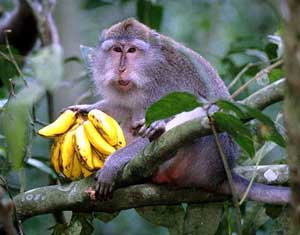 |  | |
Alas Kedaton or “Holy Forest: is a small forrest measuring 12,00ha where you can see hundreds of monkeys in their natural habitat. It's one of the place in Bali where monkeys |
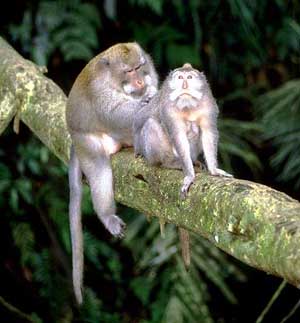 exist, free and peaceful. There are hundred of monkeys in this forest and high up on the big trees many bats area hanging and singing with their loud voices.
Sangeh:Monkey Forest Bali

Sangeh is the village whose northern part covers about 14 hectares of a holy homogen forest of “Pala” trees with hundreds of monkey in habitants. The trees cannot be found on any other part of Bali and their existence in this village remains a mystery. Look for a lovely mossy temple, which is hidden amongst the tall and gracious “Palatrees”.

Tuesday, July 31, 2007
The Kama Sutra: The Art of Balinese Loving
Preparing for the Act Of Love
After several classes on the importance of grooming, alluring attire and creating a sexy atmosphere my husband and I were ready to get into the sexual loving. We had decided to abstain from love making during those first few weeks. Our desire for each other was building strongly as we explored, teased and became more intimate than we had ever been before.
"Women, being of a tender nature, want tender beginnings"
"Whenever he sits with her on the same seat or bed he should say to her, 'I have something to tell you in private', and then, when she comes to hear it in a quiet place, he should express his love for her more by manner and signs than by words." KS
It was like meeting all over again and seeing each other with different eyes as we followed the KS. Becoming intimate again rekindled the fires by simply paying attention to all the small details we had come to let fall away as our marriage had aged. We dated and went for romantic bike rides on the waterfront. We took turns massaging and pampering one another. It is like an entirely different marriage. We had dinner parties and laughed and went out with friends. We surprised one another with gifts. We were so ready to commence with lovemaking.
Of The Ways of Exciting Desire
"At the commencement he should rub her yoni (vulva) with his hand or fingers, and not begin to have intercourse with her until she becomes excited, or experiences pleasure." KS "…he may make use of certain things which are put around the lingam (penis) to supplement its length or it's thickness, so as to fit the yoni." KS
"Some women of the harem, when they are amorous, do the acts of the mouth on the yonis of one another, and some men do the same thing with women. The way of doing this should be known from kissing the mouth. When a man and women lie down in an inverted order with the head of the one towards the feet of the other and carry on in this congress, it is called the congress of the crow". KS
The Kama Sutra goes into great details on biting, scratching and striking to achieve arousal. As boundaries differ, this should be done with the couple's own discretion. "The various modes of enjoyment are not for all times or for all persons, but they should only be used at the proper time, and in the proper countries and places." KS
Mouth Congress
Biting the sides: Hold the head of the penis with your fingers, press the sides of it with your lips and teeth, gently nibble. Outside pressing: Press the head of the penis with lips closed together and kiss it. Inside pressing: Put his penis into your mouth while pressing it with your lips and slide it out of your mouth. Kiss, rub and tease the penis with your lips and tongue. Sucking a Mango Fruit: forcibly kiss and suck his lingam. Swallowing up: put the entire penis into your mouth and press it to the very end.
Various Kinds of Congress (Sexual Positions) While the woman lies on her back.. The widely opened position: The woman arches her head back and raises her pelvis off of the bed toward her partner. The yawning position: When she raises her thighs and keeps them wide apart. She can also place them on his shoulders. The clasping position: The legs of both the man and the woman are stretched straight out over each other. The pressing position: After intercourse has begun the woman presses her lover with her thighs. The twining position: The woman places one of her thighs across the leg of her lover. The mare's position: The woman forcibly holds the penis in her vagina with her pelvic floor muscles. The rising position: The woman raises her legs straight up, above the shoulders of the man, who kneels in front of her and introduces his penis into her yoni, She increases the friction by squeezing her thighs together. The pressed position: She places her feet on his chest. Fixing of a nail: Instead of placing her leg on her partner's shoulder, the woman places her heel on the man's forehead. The turning position: When lovers are making love in the classic man on top position the man can lift one leg and turn around without withdrawing from her. Standing Position: The suspended congress: The man leans against a wall while the woman puts her arms around his neck and he lifts her by the thighs or locks his hands under her buttocks. Woman in Superior Positions
"When the woman holds the lingam in her yoni, draws it in, presses it, and keeps it thus in her for a long time, it is called the 'Pair of tongs'. When while engaged in this congress, she turns round like a wheel, it is called the 'top'. This is learnt by practice only". KS
Animal Positions
The elephant posture: The woman lies with her breasts, stomach, thighs and feet all touching the bed, and the man lies over her with the small of his back arched inward.
The congress of a cow: The woman takes a hands and knees position while the man mounts her from behind.
Suggestions for the man for pleasing his partner: Moving forward: The man moves back and forth in a straightforward manner. Churning: He holds the penis with his hand and moves it around in the vagina. Piercing: He penetrates the vagina from above and pushes it against her clitoris. Pressing: Pushing the penis forcefully against the vagina. Giving a blow: He removes his penis from the vagina and strikes it against the vulva. Blow of the Boar: He rubs both sides of the vagina with his penis. Sporting of the sparrow: moving the penis rapidly and lightly in and out of the vagina.
"….if the male be long timed, the female loves him the more, but if he be short timed; she is dissatisfied with him". KS
Doesn't look like much has changed in the ways of sexual gratification. This should keep all of us busy for a while. The Kama Sutra was written by a man, primarily for men in a mans world so take this info with a grain of salt. But it was fun to experiment and the closeness really did help bring us closer together in our relationship. Just the act of sharing something fun and sexy together brought some much needed lightness into our lives.
After several classes on the importance of grooming, alluring attire and creating a sexy atmosphere my husband and I were ready to get into the sexual loving. We had decided to abstain from love making during those first few weeks. Our desire for each other was building strongly as we explored, teased and became more intimate than we had ever been before.
"Women, being of a tender nature, want tender beginnings"
"Whenever he sits with her on the same seat or bed he should say to her, 'I have something to tell you in private', and then, when she comes to hear it in a quiet place, he should express his love for her more by manner and signs than by words." KS
It was like meeting all over again and seeing each other with different eyes as we followed the KS. Becoming intimate again rekindled the fires by simply paying attention to all the small details we had come to let fall away as our marriage had aged. We dated and went for romantic bike rides on the waterfront. We took turns massaging and pampering one another. It is like an entirely different marriage. We had dinner parties and laughed and went out with friends. We surprised one another with gifts. We were so ready to commence with lovemaking.
Of The Ways of Exciting Desire
"At the commencement he should rub her yoni (vulva) with his hand or fingers, and not begin to have intercourse with her until she becomes excited, or experiences pleasure." KS "…he may make use of certain things which are put around the lingam (penis) to supplement its length or it's thickness, so as to fit the yoni." KS
"Some women of the harem, when they are amorous, do the acts of the mouth on the yonis of one another, and some men do the same thing with women. The way of doing this should be known from kissing the mouth. When a man and women lie down in an inverted order with the head of the one towards the feet of the other and carry on in this congress, it is called the congress of the crow". KS
The Kama Sutra goes into great details on biting, scratching and striking to achieve arousal. As boundaries differ, this should be done with the couple's own discretion. "The various modes of enjoyment are not for all times or for all persons, but they should only be used at the proper time, and in the proper countries and places." KS
Mouth Congress
Biting the sides: Hold the head of the penis with your fingers, press the sides of it with your lips and teeth, gently nibble. Outside pressing: Press the head of the penis with lips closed together and kiss it. Inside pressing: Put his penis into your mouth while pressing it with your lips and slide it out of your mouth. Kiss, rub and tease the penis with your lips and tongue. Sucking a Mango Fruit: forcibly kiss and suck his lingam. Swallowing up: put the entire penis into your mouth and press it to the very end.
Various Kinds of Congress (Sexual Positions) While the woman lies on her back.. The widely opened position: The woman arches her head back and raises her pelvis off of the bed toward her partner. The yawning position: When she raises her thighs and keeps them wide apart. She can also place them on his shoulders. The clasping position: The legs of both the man and the woman are stretched straight out over each other. The pressing position: After intercourse has begun the woman presses her lover with her thighs. The twining position: The woman places one of her thighs across the leg of her lover. The mare's position: The woman forcibly holds the penis in her vagina with her pelvic floor muscles. The rising position: The woman raises her legs straight up, above the shoulders of the man, who kneels in front of her and introduces his penis into her yoni, She increases the friction by squeezing her thighs together. The pressed position: She places her feet on his chest. Fixing of a nail: Instead of placing her leg on her partner's shoulder, the woman places her heel on the man's forehead. The turning position: When lovers are making love in the classic man on top position the man can lift one leg and turn around without withdrawing from her. Standing Position: The suspended congress: The man leans against a wall while the woman puts her arms around his neck and he lifts her by the thighs or locks his hands under her buttocks. Woman in Superior Positions
"When the woman holds the lingam in her yoni, draws it in, presses it, and keeps it thus in her for a long time, it is called the 'Pair of tongs'. When while engaged in this congress, she turns round like a wheel, it is called the 'top'. This is learnt by practice only". KS
Animal Positions
The elephant posture: The woman lies with her breasts, stomach, thighs and feet all touching the bed, and the man lies over her with the small of his back arched inward.
The congress of a cow: The woman takes a hands and knees position while the man mounts her from behind.
Suggestions for the man for pleasing his partner: Moving forward: The man moves back and forth in a straightforward manner. Churning: He holds the penis with his hand and moves it around in the vagina. Piercing: He penetrates the vagina from above and pushes it against her clitoris. Pressing: Pushing the penis forcefully against the vagina. Giving a blow: He removes his penis from the vagina and strikes it against the vulva. Blow of the Boar: He rubs both sides of the vagina with his penis. Sporting of the sparrow: moving the penis rapidly and lightly in and out of the vagina.
"….if the male be long timed, the female loves him the more, but if he be short timed; she is dissatisfied with him". KS
Doesn't look like much has changed in the ways of sexual gratification. This should keep all of us busy for a while. The Kama Sutra was written by a man, primarily for men in a mans world so take this info with a grain of salt. But it was fun to experiment and the closeness really did help bring us closer together in our relationship. Just the act of sharing something fun and sexy together brought some much needed lightness into our lives.
The Art of Sexual Intimacy
- do you feel comfortable talking about sex?
- How did you learn about sex?
- Growing up, did your parents communicate and discuss sexuality openly, or did you just get "the birds and the bees"?
- Have you utilized resources such as books, videos, or seminars to give you a better understanding of sex?
- Do you have any fears or inhibitions concerning sex?
- Have you communicated to your past partners and current partner your feelings and needs when it comes to sex?
- Do you have a healthy attitude towards sex?
Since the beginning of recorded history, people have been writing about sex: Plato, Shakespeare, Anais Nin, and Danielle Steele, to name just a few. Popular magazines today -- like Cosmo, Playboy, Vanity Fair, Penthouse, and Glamour -- headline such topics as "Your top sex and love questions answered," "Seize the night," "Your sexual peak is now," "The politically incorrect orgasm," and "Making sex a joy not a job." Television talk shows are always looking for ways of improving their ratings; the surefire way to do this is to talk about sex. Turn your television on any afternoon, and you will find one or more talk shows discussing some topic related to sex.
Why is the media so focused upon bringing sex to us? What is the purpose of all this hoopla? Why doesn't the media focus more on history, philosophy, or the sciences? Why are they so intent on exploring the subject of sex, with such intensity? The obvious answer is: public demand. Our society today craves knowledge about sex. Why do we have such a hunger for this knowledge? Many of us are afraid of openly discussing this topic of sex. We turn to passive forms, like watching television and movies or reading romance novels, in our quest for knowledge that surpasses what we learned in 10th grade Health class. Seriously, during your adolescent years, was your curiosity about sex satisfied by what you learned at school or from what your parents told you? Considering the non-stop media hype on the subject of sex, it appears that our curiosity was not satisfied. We still want and seek more knowledge.
I feel that sex is still the touchiest subject in the world today. At school, we learn about the basics: anatomy, birth control, and sexually transmitted diseases. At home, what we learn about the emotional side of sex is greatly dependent on our parents and how comfortable they feel about discussing the subject. If you were lucky enough to have parents who were open, you probably have healthy ideas about sex. However, if you (like many or most of us) were raised in a family that never really talked about sex, you may have received the message that sex is not to be discussed, that it is dirty, or that it is a sin. As we grow up, we start to realize that our sexuality and sensuality are very important parts of who we are, and that sex plays a very important role in our close, intimate relationships. Many of us, however, have not acquired the sexual knowledge or skills that are needed to attain the highest level of intimacy in a relationship. No wonder there are so many TV programs devoted to various aspects of sex and human sensuality. There is a huge gap between what we learned in school and what we need to function in a loving, intimate, adult relationship.
Despite whatever deficiencies may have characterized your adolescent education about sex and intimacy, you need to take responsibility for acquiring more thorough knowledge on these topics. Like everything else, it starts with you. Make the time to learn more about sex. Get some books out of the library, rent some educational videos, search the Internet, and/or go to lectures and seminars. Women, pick up a copy of a men's magazine; men, explore your horizons and read some of the women's magazines. You will be surprised at what knowledge you can gain. To really understand sex and to have a fulfilling, intimate, sexual relationship with another person, you need to do the work. You need to educate yourself. I cannot stress this enough. Although sex is just one component of a relationship, it is an area where you and your partner can learn to share the beauty and joy inherent within each of you. You owe it to yourself and you owe it to your partner.
Work together to expand your sexual knowledge. Your sexual intimacy will flourish, and your love for one another will rise to new heights. You do not have to make a mission out of learning every little detail about every sexual technique and then practicing it all with clinical precision. Just take the time to find out, slowly, what works for you and your partner. It is not only important to learn about sex; it is equally important to learn about your own body. Take the time to listen to your body and to your feelings. Explore your body, with or without your partner. It starts with you, finding out what stimulates you sexually. Once you really know what you like, it becomes easier to communicate this to your partner. Removing the guesswork in your sexual relationship will provide a big relief for your partner and for yourself. Remember, your partner does not have a manual that shows him or her what sexually stimulates you and gives you pleasure.
As with every other realm of a relationship, you have to be able to communicate your needs to your partner in a sensitive, compassionate way. Telling your partner, "Not like that!" is not being sensitive. Focus on the positive, and let your partner know when he or she is doing something that pleases you. Verbal communication does not stop during the throes of passion. Communication is absolutely essential in order to keep sexual intimacy alive between both of you. You can communicate not only by using words, but also by using body language. Using the movement of your body to demonstrate how you are feeling is a natural, instinctive form of communication. If you are enjoying the experience you are sharing, let your partner know this by using words, a moan, a groan, or other body language. Your expression of pleasure will reinforce your partner's behavior, making it more likely that he or she will please you in this way, again, in the future.
Why is the media so focused upon bringing sex to us? What is the purpose of all this hoopla? Why doesn't the media focus more on history, philosophy, or the sciences? Why are they so intent on exploring the subject of sex, with such intensity? The obvious answer is: public demand. Our society today craves knowledge about sex. Why do we have such a hunger for this knowledge? Many of us are afraid of openly discussing this topic of sex. We turn to passive forms, like watching television and movies or reading romance novels, in our quest for knowledge that surpasses what we learned in 10th grade Health class. Seriously, during your adolescent years, was your curiosity about sex satisfied by what you learned at school or from what your parents told you? Considering the non-stop media hype on the subject of sex, it appears that our curiosity was not satisfied. We still want and seek more knowledge.
I feel that sex is still the touchiest subject in the world today. At school, we learn about the basics: anatomy, birth control, and sexually transmitted diseases. At home, what we learn about the emotional side of sex is greatly dependent on our parents and how comfortable they feel about discussing the subject. If you were lucky enough to have parents who were open, you probably have healthy ideas about sex. However, if you (like many or most of us) were raised in a family that never really talked about sex, you may have received the message that sex is not to be discussed, that it is dirty, or that it is a sin. As we grow up, we start to realize that our sexuality and sensuality are very important parts of who we are, and that sex plays a very important role in our close, intimate relationships. Many of us, however, have not acquired the sexual knowledge or skills that are needed to attain the highest level of intimacy in a relationship. No wonder there are so many TV programs devoted to various aspects of sex and human sensuality. There is a huge gap between what we learned in school and what we need to function in a loving, intimate, adult relationship.
Despite whatever deficiencies may have characterized your adolescent education about sex and intimacy, you need to take responsibility for acquiring more thorough knowledge on these topics. Like everything else, it starts with you. Make the time to learn more about sex. Get some books out of the library, rent some educational videos, search the Internet, and/or go to lectures and seminars. Women, pick up a copy of a men's magazine; men, explore your horizons and read some of the women's magazines. You will be surprised at what knowledge you can gain. To really understand sex and to have a fulfilling, intimate, sexual relationship with another person, you need to do the work. You need to educate yourself. I cannot stress this enough. Although sex is just one component of a relationship, it is an area where you and your partner can learn to share the beauty and joy inherent within each of you. You owe it to yourself and you owe it to your partner.
Work together to expand your sexual knowledge. Your sexual intimacy will flourish, and your love for one another will rise to new heights. You do not have to make a mission out of learning every little detail about every sexual technique and then practicing it all with clinical precision. Just take the time to find out, slowly, what works for you and your partner. It is not only important to learn about sex; it is equally important to learn about your own body. Take the time to listen to your body and to your feelings. Explore your body, with or without your partner. It starts with you, finding out what stimulates you sexually. Once you really know what you like, it becomes easier to communicate this to your partner. Removing the guesswork in your sexual relationship will provide a big relief for your partner and for yourself. Remember, your partner does not have a manual that shows him or her what sexually stimulates you and gives you pleasure.
As with every other realm of a relationship, you have to be able to communicate your needs to your partner in a sensitive, compassionate way. Telling your partner, "Not like that!" is not being sensitive. Focus on the positive, and let your partner know when he or she is doing something that pleases you. Verbal communication does not stop during the throes of passion. Communication is absolutely essential in order to keep sexual intimacy alive between both of you. You can communicate not only by using words, but also by using body language. Using the movement of your body to demonstrate how you are feeling is a natural, instinctive form of communication. If you are enjoying the experience you are sharing, let your partner know this by using words, a moan, a groan, or other body language. Your expression of pleasure will reinforce your partner's behavior, making it more likely that he or she will please you in this way, again, in the future.
Sunday, July 29, 2007
Rambut Siwi Temple

Rambut Siwi Temple. Is one a cliff top overlooking a breathtaking panorama of paddy fields on one side and the black sand beach on the other. Two caves overlook the sea, each with a view of the fisherman’s boats and seabirds hovering above. The temple itself was built by Dang Hyang Nirartha. According to legend, he made a gift of his hair to the temple. Hence the name Rambut Siwi, which literally means "Hair Worship!"
This temple contains a relic, a lock of the sage's hair (rambut) that is venerated (siwi). The temple is finely built of red brick with exquisite paras reliefs depicting scenes from the ancient play "Arjuna Wiwaha". A particularly good sculpture of Rangda stands guard in the gateway facing the sea. Down on the beach there are several cave temples, one of the most important bearing a sacred spring.
Subscribe to:
Posts (Atom)
