Saturday, July 21, 2007

Bali Regency

Badung - Regency
The Regency of Badung, which is located between 08 degrees south latitude and 115 degrees east longitude, is shaped liked a “kriss”. The Regency, which has only 418.52 square kilometers of land, is divided into sixth districts (kecamatan), 40 administrative villages (desa dinas and kelurahan), and as many as 117 traditional villages (desa adat)

Buleleng Regency
Regency of Buleleng concists of 9 Subdistrict covering 146 village/administrative village and 163 traditional village with width about 1,365.88 km² ( 24.25% from wide of Bali Island). Having tropical climate influenced by monsoom and rains of during the month of October until April..

Gianyar - Regency
Demographic / Living Sum up resident(1999) as much 354.530 people, Men 180.760 people and woman 173.770 people. Sum up labor force 225.520 employees, living of dominant resident in industrial sector crafting / diligence, agriculture, commerce, and construction services

Karangasem - Regency
Regency of Karangasem with Amlapura as central town is one of the 9 Regencies / town which located in Eastern of Bali island. This regional bill broadly 839.54 km² consists of 8 sub-districts : Karangasem, Manggis, Rendang, Selat, Sidemen, Abang, and Kubu divided into 71 administrative village residented by 369,320 people, has tropical climate wih exotic natue view

Tabanan - Regency

Tabanan regency is one of 8 districts/1 city which have agriculture characteristic, with width of the area about 893.33 km² (19.9% from width of Bali island). Administratively Tabanan regency divided into 8 subdistricts, 10 administrative villages, 103 villages, 663 sub-villages, 663 environments, and 374,129 people with rate of growth 0.71%

Bangli Regency
The Regency of Bangli is one of regencies in Province Bali which doesn’t have sea area, but that way Regency of Bangli save the number of potency namely human resources, among other things the beauty panorama of Mount and Lake Batur which located in Subdistrict Kintamani.

Denpasar - Municipal city
Capital of Bali propinsi (province), south central Bali, Indonesia, 40 miles (70 km) south of Singaraja. The largest city on the island of Bali, it is also the capital of the Badung kabupaten (regency). Denpasar was the site of a suicidal battle of the rajas of Badung against the Dutch Militia in 1906.


Jembrana - Regency
Regency of Jembrana is located in the western of Bali, consists of 4 subdistricts, divided into 51 villages/administrative villages(desa/kelurahan). This area covers more or less then 841.8km² with more less than 220,000 people its density 261 people of every km.

Klungkung - Regency
Klungkung is of the smallest in Bali Province, but it has potential tourism aspect to developed. Based on the decree of the Governor of Bali Province on 1993 number 528, Nusa Penida in one of with also fixed as a tourist resort in Bali. And then base of the Regency of Klungkung Government on 1996 decree number 284 there are 18 tourist object in the regency inclusive Nusa Penida


Friday, July 20, 2007

History of Bali

Although there are no artifacts or records dating back to the Stone Age, it is believed that the first settlers in Bali migrated from China around 2,500 BC, and by the Bronze era, around 300 BC, quite an evolved culture existed in Bali. The complex system of irrigation and rice production, still in use today, was established around this time.

History is vague for the first few centuries. A number of Hindu artifacts were been found dating back to the 1st century (AD), which suggests that the main religion, around 500 AD, was predominantly Buddhist.

Bali History 01It wasn't until the 11th century that Bali received the first strong influx of Hindu and Javanese cultures. With the death of his father around AD 1,011, Airlanggha, a Balinese prince, moved to east Java and set about creating unity. Having succeeded, he then appointed his brother, Anak Wungsu, as ruler of Bali. During the ensuing period there was a reciprocation of political and artistic ideas, and the old Javanese language, Kawi, became the language used by the aristocracy.

Bali History 02With the death of Airlanggha, in the middle of the 11th century, Bali enjoyed a period of autonomy. This proved to be short lived as in 1284, the East Javanese king Kertanegara, conquered Bali and ruled over it from Java. In 1292, Kertanegara was murdered and Bali took the opportunity to liberate itself once again. However, in 1343, Bali was brought back under Javanese control by its defeat at the hands of Gajah Mada , a general in the Majapahit, the last of the great Hindu-Javanese empires.

With the arrival of Islam in neighboring Java during the 15th century, a large number of courtiers, artists, musicians and craftsmen fled to Bali. As such, the Balinese have always been creative.

Bali History 03With the spread of Islam throughout Sumatra and Java during the 16th century, the Majapahit empire began to collapse and a large exodus of the aristocracy, priest, artists, and artisans fled to Bali. For a while Bali flourished and the following centuries were considered the Golden Age of Bali's cultural history. The principality of Gelgel, near Klungkung, became a major canter for the Arts, and Bali became the major power of the region, taking control of the neighboring island of Lombok and parts of East Java.

Bali History 04THE EUROPEAN INFLUENCE
The first Dutch seamen set foot on Bali in 1597, yet it wasn't until the 1800's that the Dutch showed an interest in colonizing the island. In 1864, having had large areas of Indonesia under their control since 1700's, the Dutch government sent the troops to northern Bali. In 1894, the Dutch sided with the Sasak people of Lombok to defeat their Balinese rulers. By 1911, all the Balinese principalities had been defeated in battle, leaving the whole island under Dutch control. After World War I, Indonesian Nationalist sentiment was rising and in 1928, Bahasa Indonesia was declared the official national language.

During World War II, the Dutch were expelled by the Japanese, who occupied Indonesia from 1942 to 1945. After the Japanese defeat, the Dutch tried to regain control of their former colony, but on August 17, 1945, Indonesia declared it's independence by (it's first) president, Sukarno. After four years of fighting and strong criticism by the international community, the Dutch government finally departed, and in 1949, Indonesia was recognized as an independent nation.

History of Balinese Art

Artistically, Bali is and has always been a melting pot of cultures and traditions. The Balinese have a natural capacity for absorbing different cultural elements and blending them with their own, to produce dynamic new hybrids. Over the years, Bali has been the recipient of numerous foreign influences, namely Chinese, Buddhist, Indian, Hindu, Javanese, and most recently, Western. For centuries, artists and craftsmen in Bali worked under the patronage of the priests and the ruling classes, decorating palaces and temples. The artists themselves never signed their work and usually lived close together in artists "villages"

Generally the artists did not have much room for personal expression, as their designs followed strict aesthetic and religious guidelines, but with the arrival of European artists at the start of this century, things began to change, and Balinese artists began developing their own individual styles.

Balinese PaintingPAINTING
The place synonymous with the traditional form of Balinese painting, is the village of Kamasan, near Klungkung. Up until the beginning of this century, and under service of the king of Gelgel and Klungkung, it was only natural that the painters and illustrators, called "Sangging", should settle in this one area. As it was not uncommon for ruling families from other parts of Bali to acquire the use of a Sangging to decorate their own palaces or temples, the Kamasan style of painting quickly spread throughout the whole of Bali.

The style for which the artists of Kamasan are famous is based on the East Javanese "Wayang" art. These were basically two-dimensional, iconographic representations following strict rules and guidelines as to how the characters should be portrayed. For example, a person's characters and status can be seen from the colours used to portray them, a noble man's headdress, or even the direction in which he is facing. Noblemen always have had very refined faces, while coarse characters were depicted with large, bulging eyes and fangs. Today in Kamasan you can still find people who are dedicated to painting in the traditional "Wayang" style.

One of the most famous Kamasan artists is I Nyoman Mandra, who, aside from producing his own paintings and doing restoration work, started a school to try and keep the "Wayang" tradition alive.

It wasn't until the early 1900's, that western influence reached Bali . The use of Asian symbols in the works of, amongst others, Paul Gauguin, Toulouse Lautrec and Camille Pissaro, created a new trend for Asian-influenced art and European painters began to move to Bali. Ubud's fame for art can be traced to the arrival of the German painter, Walter Spies and the Dutch painter Rudolf Bonnet. Together, with Indonesian artists such as Gede Agung Sukawati, they established the Pitamaha Group, which encouraged Balinese artists to be more expressive and less bound by tradition.

Aside from the Kamasan school of painting, there now exists a wide range of different styles, the characteristics have been briefly listed below:

Ubud Style
Influences by the western use of perspective and everyday life subject matter, the Ubud style is one of the most 'Expressionist' of all the Balinese schools. Despite this, Ubud art still retains many traditional
features, including the attention to detail and very stylized characters. Among the better known (indigenous) Ubud artists are: Anak Agung Gede Sobrat, Ida Bagus Made, I Gusti Ketut Kobot, Dewa Putu Bedil and Made Sukada.

Batuan Style
Strongly "Wayang" based, this style involves hundreds of intricately painted representations of Balinese life, filling every available nook and cranny of the canvas. Batuan artists like I Wayan Bendi, Ni Wayan Warti and I Made Budi, make much more of a statement about life in Bali, with subject matter that includes everything from traditional village activities to camera toting tourists, & even surfers. Earlier Batuan artists, Ida Bagus Made Togog and Ida Bagus Made Wija, dealt more with the darker, supernatural side of life, with people depicted as being extremely vulnerable to the spirits and powers of nature.

Keliki Style
Keliki art is very similar to the old "Batuan Style" with the one exception being size; Keliki paintings measure 20 cm by 15 cm, and contain scenes of mythical and Ramayanic characters engaged in battle, good versus evil, on sinister backgrounds. Keliki artists also follow the tradition of the "Wayang" artists in that they seldom sign their work.

Pengosekan Style
From this village, on the outskirts of Ubud, a new style sprang up during the 60's that concentrated on just a few natural components such as birds, insects, butterflies and plants. These paintings tend to be more realistic and less expressive than the Ubud style.

Young Artists
A second movement, born of European influence, occurred in the early 60's, with the arrival of Arie Smit to the village of Penestanan. He encouraged the artists in this area to explore & experiment with vivid colours and more simple abstract forms. The paintings in this style are much more 'expressionist', with little attention to detail or perspective.

Among the better known of the "young artists" are: I Wayan Pugur, I Ketut Tangen, I Nyoman Londo and Ketut Soki.

Bali Stone CarvingSTONE CARVING
Stone carvings were mainly used to decorate temples and palaces and the carvers had much more leeway in their use of subject matter than the artists and illustrators. There is little difference between the iconography decorating temples and that of private buildings. Gateways represent the dividing line between the inner and outer worlds. As well as portraying deities and demons, the carvers included many scenes from public life and there are many temple surfaces enriched with the antics of the Dutch colonists, including scenes of bicycles, drunken parties, car breakdowns and even airplanes.

Bali's modern day centre of stone carving is the village of Batubulan, situated along the route between Denpasar and Ubud.

In the temples in North Bali there would appear to be more creative works in stone (with the exception of Pura Puseh in Batubulan). If touring in the north of Bali, it is worth taking the time to visit Pura Meduwe Karang in Kubutambahan, Pura Dalem in Jagaraga and Pura Beji near Singaraja.

At Pura Sagen Agung in Ubud works by Bali's most famous stone carver, I Gusti Nyoman Lempad, and other accomplished artists, are to be found.

Bali Wood CarvingWOOD CARVING
Wood carving, like stone carving, has traditionally featured largely in the temples and palaces on Bali, with little free standing 'sculpture' work produced commercially. Immaculately carved "demons" and "mythical beings" decorate pillars, door panels, lintels and window shutters with the aim of protecting the building/s from evil intruders. With the arrival of European influences, wood carving started to develop along more innovative and commercial lines.

Although there have been noteworthy carvers in the past, for example, I Nyoman Cokot, Ida Bagus Nyana and Ketut Nongos, artistic integrity has suffered as a result of the commercial boom in the tourist industry.

These days whole villages specialize in producing certain styles of work . The village of Mas, near Ubud, is probably the best known for its carvings of female figures, Buddhas, characters from Hindu epics and the traditional Topeng and Wayang Wong masks.

Bali TextilesTEXTILES
One of the most striking things about Bali is the rich variety of cloths and materials that are to be found in the thousands of shops across the island. However, in actual fact, very few originate here! The myriad of batik clothing and sarongs available across the island are mainly imported from Java, and most of the woven cloth (Ikat) found in and around the Kuta /Legian areas, are imported from the nearby islands of Sumba and Flores.

Bali does however, have a very rich textile industry of its own. The beautiful "Songket" fabrics worn by performers of traditional dance are a fine example. In Songket, gold and silver threads are woven into the cloth to create complex motifs of birds, butterflies and flowers, & sometimes they use so much gold and silver that the underlying cloth is barely visible.

"Endek", or "weft ikat" is another commonly used weaving method in Bali. In "weft" weaving, the "weft" threads are dyed to create the design and then are woven with plain warp threads. These pieces of cloth are recognizable by their abstract designs and bright colours.

The last common form of weaving to be seen in Bali is the "Geringsing", or double-ikat and it is perhaps the most sought after. A creation when both the "warp" and "weft" threads are dyed to their final designs before being woven together. With the exception of certain areas in India and Japan, this weaving technique can only be found in the small Bali Aga village of Tenganan, in East Bali.

Thursday, July 19, 2007

Bali Art, Painting

The place synonymous with the traditional form of Balinese painting, is the village of Kamasan, near Klungkung. Up until the beginning of this century, and in the service of the kings of Gelgel and Klungkung, it was only natural that the painters and illustrators, called 'Sangging', should settle in this one area. As it was not uncommon for ruling families from other parts of Bali to acquire the use of a Sangging to decorate their own palaces or temples, the Kamasan style of painting quickly spread throughout the whole of Bali.

Until the start of this century, the dominant form of painting was the portrayal of Hindu epics, on 'Langse' - large narratives painted either on broad, rectangular cloths or on 'Ider-ider', which were much narrower (about 30cm wide and several meters long). Langse were placed in temples as wall hangings, or used as curtains in the palaces. Ider-Ider were hung around the roofs of temples and shrines, and were used decoratively in the royal courts on festive occasions. The artists also painted on wooden boards which were placed between rafters as ceiling friezes. Aside from large representational paintings, the 'Sangging' were also expected to decorate everything from gourds, wooden altars, bamboo vessels, headboards for princely bed chambers, and in particular to illustrate astrological wall hangings on bark paper or cloth.

The style for which the artists of Kamasan are famous is based on the East Javanese 'Wayang' art. These were basically two-dimensional, iconographic representations following strict rules and guidelines as to how the characters should be portrayed. For example, a person's character and status can be seen from the colors used to portray them, his head dress, or even the direction in which he is facing. Noblemen always have had very refined faces, while coarse characters have large, bulging eyes and fangs. Today in Kamasan you can still find people who are dedicated to painting in the traditional 'Wayang' style. One of the most famous Kamasan artists is I Nyoman Mandra, who, aside from producing his own paintings and doing restoration work, bas started a school to try and keep the Wayang tradition, alive.

It wasn't until the early 1900's, that Western influence reached Bali. The use of Asian symbols in the works of, amongst others, Paul Gauguin, Toulouse Lautrec and Camille Pissaro, created a new trend for Asian-influenced art, and European painters began to move to Bali. Ubud's fame for art can bc traced to the arrival of German painter Walter Spies, and Dutch painter Rudolf Bonnet. Together, with Indonesian artist Gede Agung Sukawati, they established the Pitamaha Group, which encouraged Balinese artists tobe more expressive and less traditionbound. Aside from the Kamasan school of painting, there now exists a wide range of different styles. Some characteristics have been briefly listed.

Batuan Style - Strongly Wayang based, this style involves hundreds of intricately painted representations of Balinese life, filling every available nook and cranny of the canvas. Batuan artists like I Wayan Bendi, Ni Wayan Warti and I Made Budi, make much more of a statement about life in Bali, with subject matter that includes everything from traditional village activities to camera-toting tourists, and even surfers. Earlier Batuan artists, Ida Bagus Made Togog and Ida Bagus Made Wija, dealt much more with the darker, supermatural side of life in Bali, with people depicted as extremely vulnerable to the spirits and powers of nature.


Keliki Style - Keliki art is very similar to the Old Batuan Style with the one exception being size; Keliki paintings measure 20 cm by 15 cm. They contain scenes of mythical and Ramayanic characters engaged in battle, good versus evil, on sinister backgrounds. Keliki artists also follow the tradition of the old Wayang artists in that they seldom sign their work.


Ubud Style - Influenced by the Western use of perspective and everyday-life subject matter, the Ubud style is one of the most Expressionist of all the Balinese schools. Despite this, Ubud art still retains many traditional features, including attention to detail and very stylized characters. Among the better known.

Pengosekan Style - From this village, on the outskirts of Ubud, a new style sprang up during the 60's that concentrated on just a few natural components like; birds, insects, butterflies and plants. These paintings tend to be more realistic and less expressive than the Ubud style.

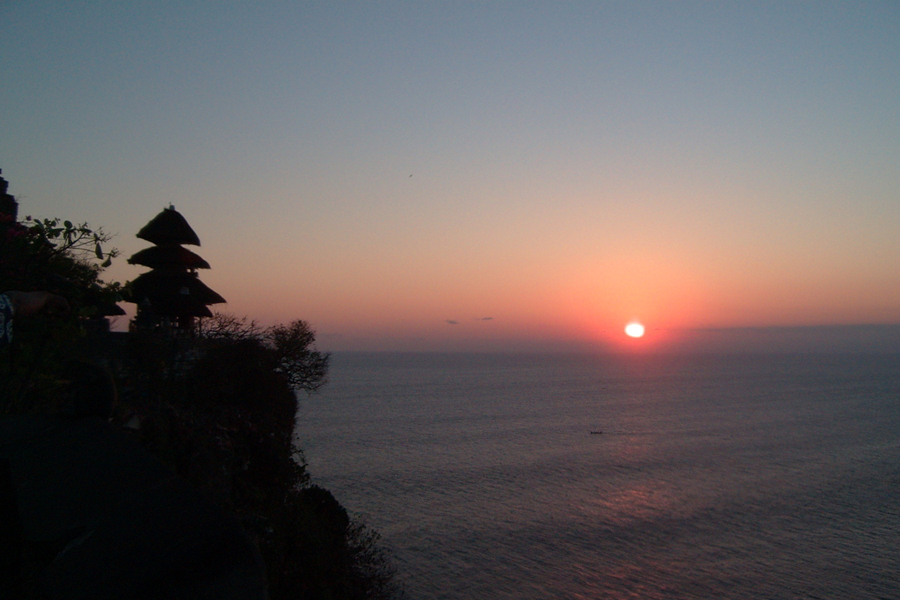
Uluwatu Temple


The shrines of Uluwatu at sunset.


Most of Bali's regencies have pura luhur, high temples that are the focus of pilgrimages during the three or five-day odalan anniversaries. Among these include Tanah Lot and Goa Lawah, the bat cave temple. While not all pura luhur are situated on the coast, all are built in awe-inspiring location, often overlooking large bodies of water. One of the most picturesque pura luhur in Bali is Pura Luhur Uluwatu.


Pura Luhur Uluwatu is one of Bali's important Sad Kahyangan temple, one of the six major temples revered by the Balinese. It was erected by Danghyang Dwijendra, a great Balinese priest who established the present form of Hindu-Dharma religion in Bali. It is said that Dwijendra achieved maksa (enlightenment, or oneness with the godhead) while meditating in Uluwatu.


The temple is perched 70 meters (230ft) above the ocean on a sheer promontory. Some of the rocky precipices drop almost 100m (330ft) into the raging ocean below. Visitors to Uluwatu are provided with a ceremonial yellow sash to wear around their waist (after paying the entrance fee). The proper attire requires that the knees are not exposed. Those wearing shorts are required to wear a sarong. Visitors are also warned to put away any shiny objects including spectacles, jewellery, and so on, as these attract the monkeys that infest the area. (One of the people in our group lost her glasses to the monkeys.)

Tanah Lot


Tanah Lot, one of the ost pmopular places of interest in Bali, is located on the coast of West Bali, at the village of Beraban in the Tabanan Regency.
It is also called Tanah Let which means ancient land and also Tanah Lod, which means the land to the south.

The temple Pura Tanah Lot, simple in its construction, is dramatic in its ocean-front location and is one of the main temples in the worship of Balinese gods.

Tanah Lot has a long history in the world of tourism.
The temple itself is built on a small promontory which is only accessible at low tide.
During high water the rock takes on the appearance of a large boat at sea, such is its shape.

Poisonous snakes live in the nearby caves to 'guard' the temple and contribute to the temple's dangerous reputation.

Sunset is the best time to visit Tanah lot, when the golden red skies frame the temple and waves crash into the rocks.
It is advisable to avoid the tourist crush here as it can be severe.

Besakih Temple

Bali's "Mother Temple"

High on the slopes of Bali's Mount Agung sits Pura Besakih, widely referred to as the "Mother Temple" of Hinduism in Bali. Pura Besakih, or Besakih Temple in English, is the largest of the island's 11,000 or so Hindu temples; its 35 shrines and halls draw devotees from all over Bali in massive numbers each year.

The world is lucky to have Besakih. In 1963 Mount Agung, a volcano, erupted and destroyed several nearby villages. Besakih was untouched.

The temple is generally agreed to date back to prehistoric times in Bali. It is named for Naga Besukian -- the dragon-god thought by pre-Hindu Balinese to inhabit this, the highest mountain in Bali. But at the beginning of the 11th Century Besakih became the state temple at a time when Bali was no mean kingdom. It has remained the state temple in some form or another ever since and is state supported today.

Like most Balinese temples, Besakih is not a closed building but a mostly open-air affair. It is made up of courtyards with altars and shrines devoted to a number of gods. And those gods have better things to do than just hang around a temple; the Balinese believe that the gods visit a temple on particular dates -- and on those dates the Balinese hold festivals to honor (or placate) the gods. Of all the temples on Bali six are "supremely holy:" Pura Besakih, Pura Lempuyang Luhur, Pura Gua Lawah, Pura Batukaru, Pura Pusering Jagat, and Pura Uluwatu. Of these, Besakih stands higher than the others -- not because it sits some 3000 or so feet above the ocean on the mountain's side, but because it is more sacred to the Balinese. It is said to be the only classless, casteless temple on the island where any Balinese Hindu can come to worship.

Bali's Hinduism is unique. Many scholars believe it gives us a view of Hindu beliefs much as they existed 1500 to 2000 years ago. Hinduism was once the dominant religion in much of Southeast Asia and empires in the region where ruled by god-kings -- empires like Funan, Sri Vijaya, Angkor, and Bali.

The Hinduism of Bali is less fragmented than that of modern India. Balinese are generally said to worship one god, Brahman, who manifests himself in various forms or personalities.

Lee Arnold, in his article on The Temples of Bali, quotes an anonymous Balinese who explains their views: "I am just one person; someday I might be a farmer, another a driver, yet another a cook, but I am still only one person." In the same way the Hindu "gods" Siva and Vishnu (Siwa and Visnu in Balinese) are really just different manifestations of the one god, Brahman, in Balinese theology. While this may be true, temples generally end up serving as places where one of Brahman's manifestations is worshipped; and Besakih is dedicated largely to Siva worship.

While the Hinduism of Bali may provide a glimpse into the religion's past it is by no means pure. Balinese religion has kept Islam at bay, but has absorbed aboriginal animism and Malay cultic ancestor worship along with aspects of Mahayana Buddhism.

The temple's anniversary, Odalan, is an excellent day to visit if you are looking for pageantry. But you should expect a crowd of several thousand people. That ceremony comes in the tenth month of the Balinese calendar, usually in April.

Tuesday, July 17, 2007

Nusa Lembongan

nusa lembongan sunset

The three sister-islands nusa Lembongan, nusa Ceningan and nusa Ceningan are a still traditional tropical paradise with romantic, secluded bays, white sandy beaches, hectares of colorful coral reefs, a great surf, and a wide choice in watersports and other activities.

Within an hour by boat from Sanur and the hectic tourism areas of the south of Bali, Lembongan, Ceningan and Penida are a safe haven of tranquility offering beautiful natural sceneries with unexpected, breathtaking panoramas.

In particular nusa Lembongan offers a number of excellent hotels and restaurants, and many activities are organized to guarantee for varied and relaxing holidays - whether you like undisturbed, lazy days on the beach working on your tan, adventurous diving, snorkeling, surfing, jet skiing or fishing, or walking or push-biking through nature.

Sukawati - Bali Art Market

sukawati-bali

One of art markets that are already popular among visitors is Sukawati art market. Sukawati road-facing market located in the Gianyar Regency has a strategic position as it is passedthrough during the tour to some destinations to the east. Sukawati art market is close to the village of Celuk, the center of gold & silversmiths. You can drop in after watchingbarong and kris dance performance in the morning. It can be accessed through bemo transport, tour bus or taxi. Spending a nice holiday on the island of Paradise is full ofendless experience. This tiny island has so many treasures andchallenging adventure to explore. See the unique rice terraces in Tegalalang or Jatiluwih with its serenity and beauty on the rice fields. Or follow and inhale fresh air along the rapid on the river with a wide choice of different rapid. Another activity you will enjoy is an original “shopping adventure” to hunt souvenirs and the like in the art market. It is just like a myriad of art shops that offers wide range of products. Simply one stop-shopping. Many items sold in Kuta or other areas originate from here and are considerably cheaper if bought here. One outlet may provide more than one item, like garments, souvenirs, paintings (unframed),basketry, colorful kites and so on. Buying giveaways to commemorate the holiday has to be a must. So take advantage the holiday time to find out something memorable on the art market of Sukawati. This market is very unique as it is already open in the early morning and visited by both domestic and foreign visitors. It is very close to other destinations in the Gianyar Regency. A good place to explore the shopping experience in a natural vway, get in touch with common people and see how the locals go bout the art of negotiation. Yes, shopping is also an art of experience. On the one hand, you may enjoy many kinds of art products all in one spot. It reflects the diversity of local art and crafts and the creativity of its people. You will get a new experience in the ‘art of buying’. You must bargain the price eventhough the vendor offers you a “morning price.” Meaning especially low, to start off the trading day with a few sales already and make the day a successful one. It does not mean you have to accept it as it is, it’s not a fixed price. If you are good at bargaining you will get the best price you can afford and the vendor keeps “smiling and thanking you”. If they don’t smile anymore, you know his cost is higher than your offer. Good at bargaining is a bit more than insisting on a price. You need to provide a logical reason why your offer is so low and still should be accepted.

Leak - Bali


In Bali, people have a bad image of Leak. They believe that Leak can make one fall sick or killed. One wishing to learn about leak should devote his or her self to Durga, in hope that She may bestow upon one the gift of being able to use leak’s mantra effectively. After having achieved one’s end by means of offering and prayers recited during a mystic dance in the middle of the night in the graveyard, then he will transform into a leak.

If you spend your days with Balinese, you will probably get a story about Leak or Balinese magic. And sometimes it is hard to believe it, but often it will make you very curious. To get someone that can show you about this magic is not as easier as you get someone who can tell you about Leak.

But there is a chance for you to get more information about it now. In Panjer, southern of Denpasar, someone can tell you and show some parts of this magic. His name is Ngurah Harta, a young spiritual figure.

Recently, he showed what a leak was in front of many audiences in a seminar on Leak in Udayana University. And he has a plan to hold a workshop on Leak where he will show how the process of becoming a leak is. Unfortunately, however, you will not be able to ask him to show his magic anytime you want. Discussing how to show the magic is considered to be taboo.

A leak has a power to change its appearance into an animal, a bike or a car, a flaming ghost (endih), a demon devil, and others that he wants.

A Leak has several ways to change its appearance: First, what Balinese call leak pamoroan. It can change completely into animals that appear only during the night. They try to suck their victims or just frighten them.

Second, Tluh, a change of the appearance but only its facial expression: The face is swollen, the eyes are distended and glowing with the fixed gaze. They appear at daytime, exert themselves to stab their enemies into stomach with a knife hidden in their hand.

Third, higher level is tranjana. They can appear during the day or the night. Their appearance is only to be seen indistinctly, partly invisible, or as a shadow to straggle his victim.

However to harm or kill someone, leak can also use papasangan. It does not need to change his or her appearance. Sometimes, leaks are seen involved in fights, measuring their power one against another. Common people usually are unable to see the fights. And the one who losses the fight will fall ill or will show sitting of blood and is doomed to death.

A trained (leak’s master) will usually find it much easier to transform its performance.. Having concentrated on a shape of an animal he is going to change into and recited magical words (mantra) properly, then he will transform directly into a leak.

The leak is considered to be lower than mankind because what he eats include corpses and everything putrefied. He sees a dead dog as a delicious food and he mistakes foul smell for fragrance and perfume.

Actually, Leak is not as bad as people think. It is like a knife: It can help us or hurt us, depending on how and what we use it for. Mangku Ketut Rnam said that Leak more is like a sharpened knowledge and “it is not bad as people think, it can be used to help people although it can hurt people, too.”

LK. Suryani, meditation expert, also shared Mangku Tetut Rnam’s view, saying that people have misperception about leak. “People just see it from the negative side. They do not realize that leak is just like a meditation or other kinds of science,” she said.

She believes that leak still exist in Bali.

Ngurah Harta realizes that challenges facing those who already have a bad image about leak. “Leak is one of our heritages that need to be retained to prevent it from extinction. If leak is said to be a bad thing, I do not agree. In fact, it will entirely depend on individuals themselves. If leak is used for healing purposes, then it means good but when leak is used to harm people, it means bad,” he said.

Bali - Nyepi Day


ogoh-ogoh, nyepi day

These day for fasting are the only holy days calculated according to the Hindu - Balinese solar calender and Nyepi is meant as the Hindu - Balinese New Year’s day. Annually at the beginning of the tenth month or at the end of the ninth month or in March. Nyepi day is celebrated throughout Bali. For year 2007 will clelebrate on 19th March 2007.

These fasting days are guided by the rotation of earth around the sun and have a mystical and coslogical meaning, the festival of lasts for three days. At the end of the ninth month, on the first day, ceremonies are carried out dedicated to the gods, charu (offering) are also given to mother earth and to all powers of the netherworld (spirit). On this day late afternoon the peoples bring the ogoh - ogoh (symbol of spirit) around to the village, to let the spirit away from the village.

On the second day, very early in the morning, before arise people begin taking a bath, which is then followed a small breakfast. Soon after sunrise, people commence fasting ceremonies and stay indoors. People are not allowed to steam rice or light fires. In the evening they may not use lamps. All people young and old, carry out fasting and may not take meals for twenty four hours. Traffic is completely stopped except for capital ambulances and policeman who are on duty, airport in Bali are closed too except in emergency flight.

Balinese Language

Indonesia is an amazing country, 17,000 islands, 180 ethnic groups and many languages.

Most people on Bali speak Bahasa Indonesia (Indonesian) but all the Balinese people also speak Bahasa Bali ( Balinese). These language are of course related but are different enough that someone from Java could not understand a conversation in Balinese.

Roughly speaking the 3 main levels, High (Ida), Middle (Ipun) and Low (Ia) are
Here are some words in Bahasa Bali:

Good - becik
Bad - corah
Friend - switra
Husband - rabi
Wife - istri
Child - putra (boy), putri (girl)
How are you? - kenken kabare
What is that? - Napi punika?

Here’s 1 to 10

1 - siki
2- kalih
3 - tiga
4 - pat
5 - lima
6 - enem
7 - pitu
8 - kutus
9 - sia
10 - dasa

- Thank you so much = Terima kasih banyak ya = Matur suksma ping banget nggih.

- I’m Fine = Saya baik-baik saja = Tyang becik-becik kemanten.

- How are you? = Apa kabar? = Punapi gatrane?

- Where is this? = Apa nama daerah ini? = Napi wastan gumine niki?

- Who is your name? = Siapa nama anda? - Sira pesengan ragane?

- Excuse me, I want to ask you something = Permisi…saya mau bertanya = Nunas lugra…tyang jagi metaken.

- Have you boyfriend/girlfriend? = Kamu sudah punya pacar? = Ragane sampun maduwe gagelan?

- Please don’t said alike that = Jangan bicara begitu! = Sampunang ngeraos kenten!

- Excuse Me, Can’t I past here? = Boleh saya lewat sini? = Dados tyang ngambahin meriki?

- Happy Galungan Day = Selamat Hari Raya Galungan = Rahajeng Rerahinan Galungan.

- Where the Tanah Lot? = Di mana tempatnya Tanah Lot? = Ring dija genah Tanah Lot?

- How much this one? = Berapa harganya ini? = Aji kuda niki?

- I wont to go back right now = Saya mau pulang sekarang = Tyang jagi mapamit mangkin

- Where you want to go? = Mau pergi ke mana? = Jagi lunga kija?

Tampaksiring Presidential Palace

istana presiden - bali

Tampaksiring Presidential Palace is situated more less at altitude of 700 meters above the sea, located at the top of the hills in Tampaksiring Village, Tampaksiring District, Gianyar Regency, Bali Island. It was the only presidential palace that built during the period of Indonesian administration of 1957-1960, fully managed by Indonesian people, initiated by the first Indonesian President: Soekarno.
The name of Tampaksiring derives from two words of Bali language, tampak means sole of the foot and siring means oblique. According to legend which was noted on palmyra palm Usana Bali, this name taken from the trace of a king’s sole of foot, the king name was Mayadenawa. The area of the forest that stepped over by the King Mayadenawa with walking on his slanted foot was memorized as Tampaksiring.

The Tampaksiring palace was constructed gradually, with its architect: R.M Soedarsono. The first building was Wisma Merdeka and Wisma Yudhistira in 1957, continued to complete in 1963. then, for the interest of ASEAN SUMMIT XIV’s activities, in Bali on 7-8 October 2003, anew building was established and Balai Wantilan was renovated, the new building has its own entrance furnished with Bentar Temple, Kori Agung, as well as Parking Lot equipped with its Balai Bengong.

The Tampaksiring palace is functioned as president and vice president official programs in the manner of governmental and state events, furthermore it is also a place for president and vice president and their families as well as for the state guests to rest. It was noted, the state guests who have visited the Tampaksiring presidential Palace, among others; President Ne Win from Burma (now is Myanmar), President Tito form Yugoslavia, President Ho Chi Minh from Vietnam, The Prime Minister Nehru from India, The Prime Minister Khrusschev from Uni Soviet, The Quin Juliana from Dutch, and Caesar Hirohito from Japan.aloooo

The Tampaksiring Presidential palace area now comprises five main buildings and one pendapa. Two of the main building were Wisma Merdeka (1200 Square meters) and Wisma Negara (1476 squares meters) that separated by fissure in the hill with the depth of 15 meters more and less, but connected to a bridge of 40 meters along, the other three main buildings are named Wisma Yudishtira, Wisma Bima, include the space for conference, and Balai Wantilan.

Monday, July 16, 2007

Art & Dance

Baris Dance
Baris Dance Just as the Legong is essentially feminine, Baris, atraditional wardance, glorifies the man hood of the t...

Barong Landung Dance
The giant puppet dance take place annually on the island of Pulau Serangan and a few other places in southern Bali.

Gatot Kaca Statue
This statue was built in 1993, located at the center of road intersection at the northeast of Bali International Airport...

Kebyar Dance
It's a male solo dance like the Baris but with greater emphasis on the performer's individual abilities. There are vario...

Keris Dance
In the Barong play, Bali's mythical guardian, Barong, battles Rangda, the demon - Queen. barong's supporters are a group...

Painting
Ubud Style
influenced by the Western use of perspective and everyday-life subject matter, the Ub...

Puri Lukisan / Gallery
The Museum Lukisan Ratna Warta, usually called the Puri Lukisan (the palce of painting), was opened in 1953. Set amongst...

Textiles
One of the most striking things about Bali is the rich variety of cloths and materials that are to be seen in thousands ...

The natural world to the Balinese is one held in balance by two opposing forces: the benign, beneficial to man, and the ...

Carving
Stone Carving
Stone carvings were mainly used to decorate temple and palaces and the carvers had much more leeway...

Jangger Dance
The flute begins an eerie tune, and faraway voices chant a strange song that flows from a loud melody to a nearly inaudi...

Jauk Dance
The Jauk Dance As a classical solo performance expressing the movements of a demon, Jauk is derived from a traditiona...

Kecak Dance
The dark expanse of the banyan tree above the temple gate casts a dense shadow on the courtyard and the carvings that fl...

Legong Keraton Dance
In legends, Legong is the heavenly dance of divine nymphs. Of all classical Balinese dances, it remains the quintessence...

Pendet Dance
Pendet is the presentation of an offering in theform of a ritual dance. Unlike the exhibition dances that demand arduous...

Ramayana Ballet
Basically, it tells the same story of Rama and Sita as told in the Kechak but without the monkey ensemble and with a nor...

The Gamelan
Balinese music is based around an instrument known as the gamelan. The gamelan is such a central part of Balinese music ... Topeng Dance
A mask dance where the dancers have to imitate the character represented by mask. A full collection of Topeng masks may ...

Temple

Hinduism In Bali

Hindu temple - Bali

Taman Ayun Temple - Mengwi Bali

Taman Ayun Temple- Mengwi Bali

Very distinctive pagodas symbolising the sacred mountain Mahameru, residence of the Supreme God surrounded by a moat in this lovely temple in Mengwi.

Originally dated from 1634, Taman Ayun has been restored and enlarged in 1937. On its festival day (odalan) hundreds of women come into the temple bringing colorful offerings, which they place together in front of the merus.

The temple of Taman Ayun in Bali’s Mengwi district, has long been well known as a tourist attraction and is about either kilometres from Denpasar on the road to Singaraja via Bedugul.
The temple can be found on the left hand side of the road very close to the crossroads in Megnwi at which you must turn right if travelling from Denpasar.
There is tample parking.

The temple was built by I Gusti Agung Anom, a founder of the Mengwi kingdom in 1934, and were skilfully and renovated in later years, giving its present appearance which tourists find so attractive and interesting.
The name itself means beautiful garden.
It is built on a high tableland which is surrounded by ponds.
This gives the effect from afar that the temple is floating on water.

The temple complex has three ground areas which rise in levels.
In the most external one there is a general purpose hall which is used for religious ceremonies and for staging of dances.
Close by is a decorative fountain.

In the central grounds is a building called the ‘bale pelik’ with beautiful carvings with interesting reliefs and statues of the nine gods, Dewa Nawa Sanga.

In the innermost court, there are twenty nine buildings which function as places for the gods and goddesses.
There are other buildings which house religious regalia used in the ceremonies.

There are multi-roofed structures, some of them having eleven roofs called ‘meru meru’.
The central section is surrounded by a small pond, thus the whole complex is symbolic of the great Mandhara Mountain turning in a sea of milk.

Many people visit this temple, not for its antiquity as it was only renovated in 1937, but for its ambience and air of serenity.

The temple has an ideal recreational garden, the air is cool and the still waters provide a safe environment for all sorts of aquatic creatures which live in the ponds.

LOCATION

BALI ISLAND OF GODS AND DEMONS.

Both magical and mythical, this land of volcanic lakes, spectacular rice terraces, stunning tropical beaches, ancient temples and palaces is and exotic melting pot of cultures and peoples. Renowned of its unsurpassed architecture, traditional theatre, dance and elaborate religious festivals, the colorful Balinese culture is a dynamic force that is constantly synthesizing the old and the new, the traditional and the innovative.

LOCATION
Bali is one of more than 18 thousands island in Indonesia. It is located between the two islands Java & Nusa Tenggara, between 8 03 40 8 degree South latitude and 114 25 & 115 42 40 degree East longitude.
Bali has 5.632,86 square kilometers of land. The total population is approximately 3.2 million people.
Standard time zone is UTC/GMT + 8 hours.

Map of Bali

REGENCIES
As a part of 30 provinces in the Republic of Indonesia, Bali is divided into 8 regencies ( Badung, Gianyar , Tabanan , Bangli , Karangasem , Jembrana , Buleleng and Klungkung, 1 municipal city (Denpasar), 51 districts and 666 administrative villages.
Denpasar is the capital city of Bali province.

Mount Agung is used as orientation and considered North (Kaja) while the sea is considered South (Kelod). This is the reason why "south" in Buleleng is the opposite of "south" in Badung. In Hindu perspective, north direction (mount) is a holy place while on the southern part is the insulted place.

In the division of area, it is analogized the anatomy of the body: head, body and legs as utama (main), madya (medium) and nista (insult). Therefore, the holy place is located in north edge, in the middle as a place of residence and in the south as place of cemetery. Even, for sleeping, head is faced to north or east and legs are directed to south or west.

THE PEOPLE
The Balinese are one of the 250 ethnic groups in the Indonesian archipelago. Most of them (95%) are Hindus, a religion which came from India, passing through Sumatera and Java. After the fall of Majapahit empire all the Hindu aristocrats and the common people fled to Bali, bringing along their religion, traditions, literature and arts. Other religions like Christianity or Moslem, Buddhism are also in Bali. But all live in peace, there is no conflict of religion or conflict of ethnics. The population of Bali are three million people. Most of them live in the southern part of the island. Here the tourist resorts are located such as Sanur, Kuta and Nusa Dua. The Balinese people are very creative. They have created and are still creating various kinds of artistic creativities such as wood carving (statues), paintings, gold and silver smith, handicrafts, dances and religious offerings. Nearly everyday there are religious ceremonies in the temples spread all over the island. There are the so called "Bali Aga"; people, the original Balinese communities in several places like in Tenganan or Trunyan. It is worthwhile to visit them there.

CLIMATE
Bali has tropical climate all year with two different seasons namely dry season from April to October and wet season from November to March. The average temperature hovers around 30 degrees Celsius year-round. The average yearly rainfall between 893,4 mm till 2702,6 mm with average humidity is 79%.
Bali Weather

POPULATION
Bali has 5.632,86 square kilometers of land.
The total population is approximately 3.021.247 people.

IMMIGRATION & CUSTOMS
Immigration Offices:

Jl. D. I. Panjaitan, Niti Mandala, Complex Renon - Denpasar
Phone : (62 361) 238 168
Ngurah Rai Airport Complex, Tuban, Kuta
Phone : (62 361) 751 038
Customs regulations allow, per adult, a maximum of one litter of alcoholic beverages, 200 cigarettes, 50 cigars or 100 gram of tobacco and a reasonable amount of perfume. Photographic, video and filming equipments, radio, typewriter and car are admitted as they are recorded in you passport on entry and taken out on departure. Narcotics, arms and ammunition TV, sets and Chinese medicines are items that strictly prohibited while fresh fruit, plant and animals must be passed by the Quarantine Office.

BANK & MONEY EXCHANGE
Most foreign currencies are easily changed at banks, hotels or money changers. Banking hours are from 8.00am to 14.00 noon Mondays to Fridays, and from 8.00am to 11.00am on Saturdays. Bank in Hotels usually stay open longer hours while Money Changers are generally open till evening. ATM is available in many places, provides VISA, MASTER, ALTO and more.

MEDICAL SERVICES & HOSPITAL
Hospitals and Health Centers staffed by well trained doctors and medical-assistants are available in major tourist resort and the Provincial Capital. Public Health Centre is also available at every Sub district unit.

Sanglah Hospital
Jl. Diponegoro, Denpasar
Ph. (62 361) 227 911

SOS
Jl. Bypass Ngurah Rai 505x, Kuta
Ph. (62 361) 710 505

Clinic
Clinic SatyaNyanda
Jalan Danau Tamblingan Raya 17D Jimbaran-Bali
Ph.(62 361)774199

CONTACT NUMBERS
Police : 110
Ambulance : 118
Fire Department : 113
SAR : 115/151/111

TELECOMMUNICATION SERVICES
Bali is linked via satellite to all major countries in the world and to make an International call can be made from any private house, business center, hotel telephone, or "Wartel" (Telecommunication Counter). Internet is also can be reached at many "Warnet" (Internet Counter). For local and international phone and fax service look out for a sign like this: Int'l Direct Dialing 001 or 008 + country code + area code + local telephone number. Int'l Direct Inquiries : 102, 101
Local Inquiries : 147
Operator Assisted : 110/104

Bali Map

Geography

Area : 5,561 sq km
Capital : Denpasar
Borders : Java Sea on the north, Indian Ocean on the south, Bali Strait on the west and Lombok Strait on the east
Rivers : Ayung, Unda, Sungsang, Balian, Yeh Sumi, Petanu, and Saban
Mountains : Agung, Batukaru, Batur, and Merebuk
Lakes : Batur, Buyan, Bratan, and Tamblingan
Humidity : 80%. Rainfall : 893.44-2,702.6 mm per year
Population : 3,172,000 (2001). Density : 550 persons per sq km (2001). Average Growth : 1.18% (1980-1990)

Religion

Moslems (5.22%)
Protestants (0.58%)
Roman Catholics (0.47%)
Hindus (93.18%)
Buddhists (0.55%)

Economic Indicators

Economic Growth : 8.86%
Income per Capita : Rp. 1,090,447.49 (1990)
Exports : Garments, handicrafts, furniture, canned fish, vanilla, coffee, tuna, seaweed
Value of Exports : US$ 145,997,595 (1991)

Primary Products

Agriculture - Food Crops : Rice, corn, and horticulture
Commercial Crops : Coconut, clove, coffee, rubber, vanilla and fruits
Livestocks : Cows, buffaloes, sheeps, goats, pigs, horses, chickens, and ducks
Fishery - Fish Products : Tuna, skipjack tuna, barramundi, shrimp, seaweed, giant gouromy, and common carp
Fresh Water Fishery Area : 841.37 ha
Forestry-Forest Products : Cayuput oil, rattan, and incense
Productive Forest Area : 8,535.05 ha
Handicrafts : The Balinese are known for the outstanding wood and stone carving

Economics and Culture
Tourism is now the leading economic activity, surpassing agriculture, the traditional source of the island’s wealth. The Balinese originally thought to confine tourism to the beaches of the south coast, but they failed to reckon with the Australians and with non-Balinese Indonesians, not to mention other nationals, who flock to the island in increasing numbers. As a result, tourism now occupies somewhat less than a third of the total land area and is creeping northward. There are 110 starred hotels. The loss of sawah (irrigated land for rice cultivation) to construction is now two percent per year.

Tourism is a national preoccupation. The Balinese would do nothing to jeopardize tourism, or to harm tourists, and would resent any outside attempt to interfere with tourism. For that reason many Indonesians themselves see Bali as a retreat from the political or ethnic turmoil that they experience elsewhere. There are examples of Indonesian capital parked in Bali in small enterprises and/or vacation homes that are probably considered safer investments than elsewhere in Indonesia.

Much of this development is evident in the roadside construction of small shophouses (rumoko, i.e. rumah-toko) and factories, whose activities contribute to traffic congestion and whose installations obstruct the famous views of Balinese rice terraces. Except for limitations on height, a ruling that has been in effect since the Sukarno era, there are no zoning restrictions on building.

Commercial activity is not confined to the arts and crafts associated with tourism but increasingly to other activity as well. Bali has become an entrepot for multi-faceted business such as furniture manufacture, in which furniture is first made in Java, finished in Bali, then shipped out from Surabaya. Agriculture is also booming, with temporary imported labor from Java to help with the rice harvest.

Bali attracts this activity because it is perceived as a nice place to live, and is seen as a place of high civilization in a beautiful rural setting. But if, because of unregulated development it is no longer a nice place to live, at what point will that development turn sour? The Balinese are beginning to wonder.

Decentralization is a big unknown thus far. At the moment the provincial government is in control of the distribution of tourist revenue and taxes, 40 percent of which is distributed to the poorer kebupaten. The kebupaten boundaries are still the same as the areas of the old royal kingdoms: Dan Pasar, Klungkung, Gianyar, Ubud, etc. How this will all be affected by decentralization is not yet known. Nor is it known how decentralization will affect the intricate irrigation system. In the worst case, each kebupaten will compete without restraint to capture the most tourists and the most enterprises. In the best case, the province and the center will still enforce some moderation. The Balinese strongly support President Megawati (she is one quarter Balinese) and seem to rely on her to keep a balance.

In any case, Balinese culture is holding its own against rapid development. The population is 93 percent Hindu (or the Balinese version of Hinduism which has a strong basis in spirit and ancestor worship). There is a “fierce national pride and possessiveness of Balinese culture as a national asset," Pringle said, “and a traditional intolerance toward foreigners, by which is meant Javanese.” There is also some antipathy toward non-Hindu Balinese such as Christians, who have been somewhat successful in making converts in some northern villages.

It is still roughly a caste society, with about 10 percent of the population in the upper castes and 90 percent in clans associated with crafts, especially smiths (goldsmiths, blacksmiths, etc). These ancient clans go back to Majapahit times and are traditionally associated with responsibility for rituals and ritual objects.

Traditional culture still has considerable importance, if some recent disputes about the high caste requirements for Balinese priesthood have any significance. Performing arts are still strong and show signs of enduring. Even transmigrant Balinese show signs of preserving their culture, as some transmigrant communities in Sulawesi have ordered Balinese gamelans to be sent to them.

Pringle suggested that the strength of the culture lies in part on the energy, resilience and inventiveness of the Balinese. They are quick to take pragmatic advantage of economic opportunity, even if it means compromising the rules somewhat. Signs of the times include Balinese carvers making “genuine” traditional Asmat carving from Papua; or an instant cremation service, consisting of a pickup truck and propane gas tank, offered for families of deceased who do not have the resources for a traditional (and expensive) cremation.

Bali: People and The Culture

HISTORY

Although there are no artifacts or records dating back to the Stone Age, it is believed that the first settlers on Bali migrated from China around 2500 B.C. By the Bronze era, around 300 B.C., a fairly evolved culture already existed on Bali. The complex system of irrigation and rice production, still in use today, was established around this time.
It appears that the main religion around 500 A.D. was predominantly Buddhist in influence. In 670 A.D., a Chinese scholar (Yi-Tsing), on a trip to India, reported that he had visited a Buddhist country called Bali.
It wasn’t until the 11th century that Bali received the first strong influx of Hindu and Javanese cultures. With the death of his father around AD 1011, the Balinese Prince, Airlanggha, moved to East Java and set about uniting it under one principality. Having succeeded, he then appointed his brother, Anak Wungsu, as ruler of Bali. During the ensuing period there was a reciprocation of political and artistic ideas. The old Javanese language, Kawi, became the language used by the aristocracy, one of the many Javanese traits and customs adopted by the cause.
With the death of Airlanggha, in the middle of the 11th century, Bali enjoyed a period of autonomy. However, this proved to be short-lived, as in 1284 the East Javanese King Kertanegara, conquered Bali and ruled over it from Java. In 1292, Kertanegara was murdered and Bali took the opportunity to liberate itself once again. However, in 1343, Bali was brought back under Javanese control by its defeat at the hands of Gajah Mada, a general in the last of the great Hindu-Javanese empires, the Majapahit. With the spread of Islam throughout Sumatra and Java during the 16th century, the Majapahit empire began to collapse and a large exodus of aristocracy, priests, artists and artisans to Bali ensued. For a while Bali flourished and the following centuries were considered the Golden Age of Bali’s cultural history. The principality of Gelgel, near Klungkung, became a major centre for the Arts, and Bali became the major power of the region, taking control of neighbouring Lombok and parts of East Java.

The European Influence

The first Dutch seamen set foot on Bali in 1597, yet it wasn’t until the 1800’s that the Dutch showed an interest in colonizing the island. In 1846, having had large areas of Indonesia under their control since the 1700’s, the Dutch government sent troops into northern Bali. In 1894, Dutch forces sided with the Sasak people of Lombok to defeat their Balinese rulers. By 1911, all the Balinese principalities had either been defeated in battle, or had capitulated, leaving the whole island under Dutch control. During World War II, the Dutch were expelled by the Japanese, who had occupied Indonesia from 1942 to 1945.
After the Japanese defeat, the Dutch tried to regain control of their former colonies, but on August 17, 1945, Indonesia was declared independent by its first President, Sukarno. After four years of fighting and strong criticism from the international community, the Dutch government finally ceded and, in 1949, Indonesia was recognized as an independent country.

THE PEOPLE


“Market Traditional ” by I Ketut Kasta
Courtesy of Museum Rudana

Life in Bali is very communal with the organization of villages, farming and even the creative arts being decided by the community. The local government is responsible for schools, clinics, hospitals and roads, but all other aspects of life are placed in the hands of two traditional committees, whose roots in Balinese culture stretch back centuries. The first, Subak, concerns the production of rice and organizes the complex irrigation system. Everyone who owns a sawah, or padi field, must join their local Subak, which then ensures that every member gets his fair distribution of irrigation water. The other community organization is the Banjar, which arranges all village festivals, marriage ceremonies and cremations. Most villages have at least one Banjar and all males have to join one when they marry. Banjars, on average, have a membership of between 50 to 100 families and each Banjar has its own meeting place called the Bale Banjar. As well as being used for regular meetings, the Bale (pavilion) is where the local gamelan orchestras and drama groups practice.

RELIGION

The Balinese are Hindu yet their religion is very different from that of the Indian variety. The Balinese worship the Hindu trinity Brahma, Shiva and Vishnu, who are seen as manifestations of the Supreme God Sanghyang Widhi. Other Indian gods like Ganesha (the elephant-headed god) also appear, but more commonly, one will see shrines to the many gods and spirits that are uniquely Balinese. Balinese believe strongly in magic and the power of spirits, and much of their religion is based upon this. They believe that good spirits dwell in the mountains and that the seas are home to demons and ogres. Most villages have at least three main temples, namely: (1) the Pura Puseh, or ‘temple of origin’, facing the mountains; (2) the Pura Desa, or village temple normally found in the centre; and (3) the Pura Dalem, aligned with the sea and dedicated to the spirits of the dead. Aside from these ‘village temples’, almost every house has its own shrine. Some temples, for example, Pura Besakih on the slopes of Mount Agung, are considered especially important and people from all over Bali travel there to worship.

Offerings play a significant role in Balinese life as they appease the spirits and thus bring prosperity and good health to the family. Every day small offering trays (canang sari) containing symbolic food, flowers, cigarettes and money, are placed on shrines, in temples, outside houses and shops, and even at dangerous crossroads.

Festivals are another great occasion for appeasing the gods. The women bear huge, beautifully arranged, pyramids of food, fruit and flowers on their heads while the men might conduct a blood sacrifice through a cockfight. There are traditional dances and music and the gods are invited to come down to join in the festivities. The festivals are usually very exciting occasions and, if you are in the are, well worth observing. Please refer to the back page (‘A Word of Advice’) for Rules.